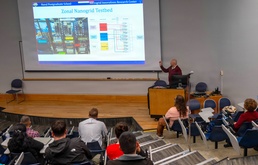
MONTEREY, Calif. — Naval Postgraduate School (NPS) students and faculty gathered, May 28, for the Microgrid Innovations Research Center (MIRC) Spring 2026 Workshop and Student Research Showcase on the NPS campus, highlighting student-led research addressing the U.S. Department of War’s (DOW) growing need for secure, resilient energy systems.
The student-focused event showcased thesis, capstone, and dissertation research on microgrids, nanogrids, digital twins, cybersecurity and more, with presentations demonstrating how emerging energy technologies could help sustain mission-critical military operations during power disruptions, attacks, extreme weather and other degraded conditions. The center’s overarching vision is to advance Navy and DOW energy resilience by accelerating the research, development, and transition of microgrid technologies and their critical applications.
According to NPS Vice Provost of Research and Innovation Dr. Michael Hesse, the student research detailed during the showcase demonstrates NPS’ role in solving operational problems because it is informed by the experiences students bring from the fleet and joint force.
“NPS research succeeds because it is grounded in operational reality,” Hesse said. “Our students bring real-world challenges into the classroom and laboratory, helping ensure our research addresses problems that matter to the warfighter. They then carry those insights back into the fleet and joint force, creating a direct pathway from research to operational impact.”
Dr. Douglas Van Bossuyt, MIRC director and associate professor in the NPS Department of Systems Engineering, explained that the workshop was designed to give the NPS community a broader understanding of the center’s activities and critical student research.
“Electricity matters to the Navy,” he said. “Electricity must be continuously available for mission-critical activities, regardless of conditions such as attacks, blackouts, extreme weather, and other issues.”
Van Bossuyt noted that the technologies and research areas showcased at the event, such as microgrids, nanogrids, digital twins, and microgrid cybersecurity, are all connected to the broader goal of strengthening energy resilience for military operations.
“Each of these pieces is part of the puzzle for ensuring energy resilience, which leads to energy security and ultimately energy dominance,” he said. “Energy is the lifeblood of the modern national defense establishment. Without energy, our radars do not operate, our ships cannot sail, our aircraft cannot fly, and we are unable to support mission assurance.”
Unlike commercial microgrid design, which often focuses on cost and energy savings, military microgrid design must prioritize resilience and the ability to sustain operations under degraded conditions.
“Military microgrid design is not a straightforward engineering exercise because available design tools focus on cost and energy savings rather than resilience,” Van Bossuyt explained. “The NPS MIRC focuses on accelerating the research, development and transition of microgrid technology for defense applications to support energy resilience and ensure mission-critical activities remain uninterrupted.”
The center has developed a web-based microgrid conceptual design tool, established multiple microgrid testbeds at NPS, and supported research on survivability, reliability, power quality and cyber resilience. It has also supported the creation of Unified Facilities Criteria 3-550-04 for Resilient Installation Microgrid Design, a comprehensive set of planning, design, construction, sustainment, restoration, and modernization documents used by DOW, and has supported more than 100 active duty and civilian students’ theses, capstone projects, and dissertations.
For Van Bossuyt, student involvement is a defining part of the MIRC’s impact.
“The military microgrid technologies being developed by the NPS MIRC and the studies the center conducts for military facilities around the globe expose NPS students to the real-world problems and solutions the fleet faces today and will face in the near future,” he said. “Our students can play a direct role in the research and analysis the center conducts, making a difference for the fleet and ensuring energy security and energy dominance.”
Among the student research solutions highlighted during the showcase was an award-winning exploration into microgrid cybersecurity. U.S. Navy Lt. Destiny Lortz, a student in NPS’ cyber systems and operations program and recipient of the 2026 Spring Quarter’s Fleet Cyber Command Award for Academic Achievement in Cyber Operations, presented her research on detecting false data injection attacks using integrated vibration and current analysis.
Lortz explained that her research focuses on quickly and reliably detecting adversary intrusions into cyber-connected critical infrastructure in cost-effective ways, suitable for operational environments with limited space.
Microgrid cybersecurity matters to the Navy and DOW, she said, “because modern military operations depend heavily on reliable, resilient and secure electrical power.”
False data injection attacks can manipulate sensor measurements or control data, causing operators or automated controllers to perceive an incorrect system state, even though the physical process behaves differently from what is reported. By incorporating vibration data, her research improved anomaly detection performance and could help strengthen protection for operational technology systems.
“Improving the ability to detect subtle cyber-physical attacks helps preserve operational continuity, reduce vulnerability and strengthen overall energy security for military systems,” Lortz added.
The joint nature of energy resilience was exemplified by a student team’s examination of Indo-Pacific energy security at the U.S. Army Garrison Kwajalein Atoll (USAG-KA), a remote Pacific installation that supports the Ronald Reagan Ballistic Missile Defense Test Site and Space Fence radar operations.
U.S. Army Maj. Miguel De Leon described his team’s research into reducing USAG-KA’s reliance on imported diesel fuel, and evaluated isolated microgrids to support the command’s mission-critical operations. The project, titled “Analysis and Recommendations for Energy Security at United States Army Garrison Kwajalein Atoll,” assessed resilience, efficiency and mission endurance in an environment characterized by long fuel resupply lines, aging infrastructure, corrosive conditions and continuous power requirements.
“For a place like USAG-KA, energy resilience directly supports operational readiness and mission continuity,” De Leon said. “These are isolated grids with no connection to an external utility, so every critical mission depends on local power generation.”
To assess potential resilience improvements, the team used operational production and consumption data from power plants, and then applied the NPS Microgrid Planner Tool to simulate hybrid energy configurations combining solar photovoltaic systems, battery energy storage, and wind generation.
De Leon stressed that the goal was not to make USAG-KA net-zero, but to determine whether practical integration of renewable energy sources could reduce diesel demand, improve flexibility, and strengthen resilience while still supporting mission requirements.
“In a remote environment like Kwajalein, resilience is not just about efficiency; it is about sustaining the mission,” he added.
For U.S. Navy Lt. Ryan Iverson, the focus was on zonal nanogrids, a concept inspired by the zonal power distribution systems used aboard U.S. Navy vessels. His thesis examined how smaller, interconnected power systems could share power and continue operating after a fault.
Iverson described zonal nanogrids as a scalable and cost-effective approach to energy resilience because they can reroute power when a unit fails or experiences a fault.
“The testbed successfully validated the zonal nanogrid’s ability to reconfigure and adapt in the event of a fault,” he said.
His research provides experimental data that supports prior simulation-based work and brings the concept closer to potential field testing and deployment. According to Iverson, the testbed, assembled from commercial off-the-shelf components, operated as a standalone system and served loads in a degraded state by sharing power among nanogrids.
Another student project examined the role of digital twins in future military microgrid operations. U.S. Marine Corps Capt. Dylan Bruns is developing and validating a digital twin of a microgrid through NPS’ research partnership with NVIDIA and its Omniverse platform.
Bruns’ goal is to create a virtual environment that replicates a physical system's behavior based on measured inputs and operating conditions. He described his work as an early step toward developing an artificial intelligence-enabled system to help operate military microgrids by anticipating problems, responding to changing conditions, and adjusting operations in real time.
“Before an AI agent can be trusted to monitor or control a microgrid, it needs a training and evaluation environment,” he said. “This project is about building that environment.”
Digital twins could support both planning and operations by enabling engineers and operators to test how a microgrid might respond to changing loads, renewable generation, battery conditions, or contingency scenarios before those conditions occur in the real world, Bruns explained. When connected to a live system, a digital twin could also help identify abnormalities, improve load prioritization and reduce downtime.
Dr. Giovanna Oriti, NPS Department of Electrical and Computer Engineering (ECE) professor, Power and Energy Lab director, and MIRC co-director, emphasized that student participation is central to the center’s work because students contribute field experience while developing technologies relevant to naval applications. Through these projects, Oriti explained, students gain hands-on experience they can bring back to the fleet and force.
Oriti’s students presented research on power converters, nanogrid testbeds, and microgrid digital twins. In addition, students working with Dr. Preetha Thulasiraman, ECE professor and associate chair for research, presented research on microgrid security and operational technology systems, including protection against adversarial exploitation.
Reflecting on the event, Van Bossuyt said this year’s student projects represent the center’s broader mission of applying interdisciplinary research to complex energy security and resilience challenges unique to naval and defense needs.
“The projects span from electrical engineering to computer science to systems engineering and beyond,” he said. “But they all align with supporting fleet needs and the broader defense mission.”
The center has already delivered analyses and technical solutions to help the Navy improve energy resilience at naval facilities. The first pilot microgrid, designed in part using the center’s methods and tools, has already been commissioned at Naval Air Station Sigonella, with additional pilot microgrids under contract and in construction.
Looking ahead, MIRC leaders outlined plans to continue the center’s focus on microgrid and nanogrid research, as well as digital twins, smart microgrids, cybersecurity and more. He also highlighted an expanding area of focus, the energy required to support artificial intelligence at bases and in operations.
Together, the projects reflect the MIRC’s mission to advance microgrid technologies from concepts to testbeds to real-world defense applications, while giving NPS students a direct role in solving energy resilience challenges that affect the fleet and joint force.
NPS, located in Monterey, California, provides warfighting-focused graduate education, including classified studies and interdisciplinary research, to advance the operational effectiveness, technological leadership and warfighting advantage of the naval service. Established in 1909, NPS offers master’s, doctoral and distance-learning certificate programs to U.S. Department of War military and civilian students, as well as to international partners, to develop warfighters and leaders who can think critically, solve complex operational problems and deliver mission-ready solutions through advanced education and research.