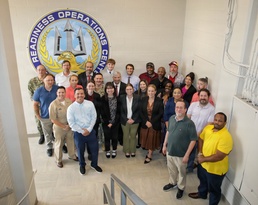
NORFOLK, Va. – Naval aviation leaders, Sailors, and civilians gathered at Naval Air Force Atlantic’s (AIRLANT) CVN Readiness Operations Center (ROC) to celebrate the opening of a state-of-the-art facility designed to revolutionize how the Navy monitors, analyzes, and improves aircraft carrier readiness across the fleet.
Located in Building V-88 on Naval Station Norfolk, the ROC operates as a centralized hub for readiness data, analytics, and decision support. By consolidating maintenance, logistics, manning, and training data, the facility provides commanders with near real-time readiness assessments to support mission execution and fleet operations. The ROC builds upon the success of the Maintenance Operations Center stood up by now retired Rear Adm. John Meier in 2018.
Rear Adm. Rich Brophy, commander, Naval Air Force Atlantic, led the ribbon-cutting and emphasized the ROC's role in advancing the Navy's data-centric transformation and improving aircraft carrier readiness. After the ceremony, ROC team members demonstrated the center's advanced analytics, artificial intelligence (AI), and machine learning tools that help fleet leaders make faster, more informed readiness decisions.
"Having access to data is one thing; transforming that data into actionable insight is another," Brophy said. "What excites me most about the Readiness Operations Center is its power to harness information, identify trends, share best practices, and solve carrier readiness challenges faster than ever before. By applying advanced analytics and innovative technologies, we are expanding the decision space for our commanders and supporting more informed, timely decisions. Ultimately, this ability strengthens our capacity to meet the Navy's strategic requirement of maintaining 80 percent of our aircraft carriers ready to operationally surge and dominate in combat whenever the nation calls."
The ROC uses advanced data platforms to create interactive dashboards that provide visibility into aircraft carrier readiness. Through AI and machine learning, the center delivers predictive and prescriptive analytics to identify potential readiness challenges before they affect operations.
The facility is staffed by programmers, data scientists, and subject matter experts from across naval aviation and carrier enterprise, including specialists in nuclear and non-nuclear Hull, Mechanical and Electrical systems, combat systems, weapons, logistics, and maintenance. The ROC leadership team includes Director, Scott Barry; CVN ROC Officer, Cmdr. Jeremy Leazer; Operations Lead, Samantha Albrecht; Technical Lead, Gregory Hitt; and Supply Officer, Lt. Melissa Howard.
In addition to its readiness analysis mission, the ROC houses a 24/7 Crisis Response Unit that provides rapid support for watch standing and command-and-control during emergent fleet operations, contingency responses, and high-stakes scenarios requiring immediate coordination among stakeholders.
The center continuously monitors historical and current readiness data for all U.S. Navy aircraft carriers, including those deployed or in sustainment, maintenance, and training phases of the Optimized Fleet Response Plan.
The opening of the ROC supports the Department of the Navy's broader effort to become a data-centric organization. By replacing fragmented, manual readiness assessments with a holistic, data-driven approach, the ROC gives naval leaders a decisive informational advantage and strengthens the Navy's ability to generate combat-ready forces.
As naval aviation evolves to meet global challenges, the ROC demonstrates the Navy's commitment to innovation, readiness, and warfighting excellence. Through advanced analytics, integrated decision-making, and continuous operational monitoring, the center supports the goal of maintaining surge-ready aircraft carriers capable of projecting power and excelling in combat operations worldwide.
AIRLANT oversees seven nuclear-powered aircraft carriers, 54 aircraft squadrons, approximately 1,200 aircraft, and more than 43,000 military and civilian personnel. The command continues to focus on people, warfighting, and readiness by delivering a combat-ready, sustainable naval air force equipped to meet today's operational demands.