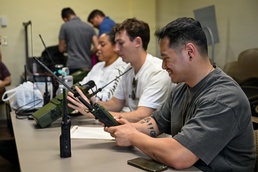
HAGÅTÑA, Guam – Cybersecurity and IT Airmen from the 439th Communications Squadron and 439th Aeromedical Evacuation Squadron partnered with the Government of Guam’s Office of Technology, U.S. Navy Reserve Sailors, U.S. Army Reserve Soldiers, and active duty Airmen to refine Guam’s emergency radio and cyber networks June 1-12.
The training, known as Cyber Guam 2026, was part of the Department of War Innovative Readiness Training program, and the third iteration of the event. Sixty service members from 18 units participated at training sites across the island.
In this iteration of Cyber Guam, participants continued work from previous years to assess physical and virtual limitations, identify vulnerabilities, share best practices, and develop the island’s emergency radio network. By partnering with OTECH, 439th CS and 439th AES Airmen had opportunities to join radio, network, and assessment teams to learn from others and hone their skills on live networks, which offered a key difference to many conventional military training opportunities on closed systems.
“Opportunities like this are fantastic because they can bring every branch and component together,” said Staff Sgt. Kyndra Ridenhour, 439th Communications Squadron infrastructure supervisor and Cyber Guam 2026 overall mission lead. “I hope the Airmen and Sailors on this trip try to experience it all, from the productive networks to the culture. I never thought this was possible, and now that I’m here, I don’t want to leave!”
For these Citizen Airmen, many of whom have civilian backgrounds in IT and cybersecurity, it was a special opportunity to spend their annual tour working with an American community to build the strategic depth of their skills.
“The difference between training at home in Westover, and training here in Guam is that the goals here are real,” said Senior Airman Stephenson Youyoute, 439th CS radio frequency technician and Cyber Guam 2026 Radio Team trainer. “So, our information, what we collect, and what we do has a real impact.”
“The IRT team have become trusted resources for our team,” said Beatrice Santos, OTECH acting chief technology officer. “We value the techniques we have learned from them, and we hope working with our team in real-life scenarios and systems over these last three years has provided a good learning environment for new service members as well.”
Staff Sgt. Marwan Al Saeedi, 439th CS cyber transport systems specialist, said he values the travel and training experience IRT offers. As a Citizen Airman who also works in IT in his civilian capacity, he feels proud to support American communities while sharing his expertise with sister service and community partners during his annual tour.
“Spending my annual tour here is both a privilege and a unique opportunity,” Al Saeedi said. “As a reservist, I get to apply the skills I’ve developed in my civilian career to train others on a real, live network. Opportunities like this are a huge win for us as Reservists and American communities because we get to train and serve where we live.”
As a military service partnership, both the Air Force Reserve and IRT share a focus on realistic military training, effective resource management, and modernizing capabilities.
Cyber Guam 2026 opened the gates for trainers and trainees to sign off on 2,000 training tasks, decommission obsolete equipment, receive live network training equivalent to $250,000 in certification costs, upgrade and deploy new network equipment, and plot 520 emergency radio receiver sites.
The unique training environment created opportunities for these efficient, experienced Airmen, Sailors, and Soldiers to think outside the box and get creative with problem solving. Members of the 439th CS were able to repurpose radio equipment and laptops scheduled for disposition to help map the island’s emergency mobile radio system and navigate Guam’s cyber network to avoid more than $700,000 in new equipment costs for the 2026 iteration.
“Our civilian experience and military training allow us to find solutions others might not see,” said Tech. Sgt. Sean Gmachowski, 439th CS radio frequency transmission craftsman. “We were able to repurpose available equipment to deliver real solutions and real savings, and that’s the kind of thinking that defines the reserve force.”
The IRT program’s goal is to provide real-world training opportunities to service members while working with American communities to solve problems in cybersecurity, medical, aerial spray, transportation, and more, at no cost to those communities.
To read more about IRT Cyber Guam 2026, click here.