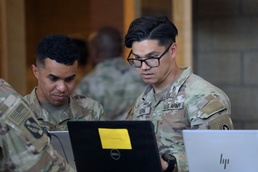
CAMP SHELBY, Miss. — As thousands of service members converge on Camp Shelby for Operation Sentinel Justice, one of the largest and most complex training exercises of its kind, accountability remains a critical component of mission success. Behind the scenes, Army Reserve human resources professionals assigned to the 312th Adjutant General Company, based in Fallbrook, California, under the 311th Sustainment Command (Expeditionary) are helping ensure every Soldier is accounted for through the Tactical Personnel System (TPS), a key element of Reception, Staging, Onward Movement and Integration (RSOI).
Operation Sentinel Justice provides Army Reserve units the opportunity to train in a large-scale operational environment, replicating the challenges service members may face during real-world deployments. As personnel arrive from across the country and move through various stages of the exercise, TPS serves as a vital tool for tracking and managing personnel accountability.
For Spc. Evelyn Jauregui, a human resources specialist with the 312th AG Company, working at the TPS station has offered both a new challenge and a valuable learning opportunity.
"We have four stations operating the Tactical Personnel System," Jauregui explained. "Our mission is to in-process and out-process Soldiers participating in Operation Sentinel Justice. Soldiers arrive, present their Common Access Cards, and we scan them into the system before they move on to their briefings and continue with their mission."
The TPS process may seem simple, but its impact extends throughout the exercise. As part of RSOI operations, TPS ensures leaders know exactly who has arrived, where personnel are located, and whether units are maintaining accountability of their Soldiers.
"The in-processing and out-processing are important because they help us keep accountability of our Soldiers and know that they're actually here," Jauregui said. "It supports security and safety while ensuring the mission gets accomplished. It's crucial that Soldiers know what they're supposed to be doing and that they're where they're supposed to be."
With participants arriving at different times from various locations, accountability can quickly become complicated.
"Sometimes units come back and ask if a Soldier has checked in because not everyone arrives at the same time," she said. "Some Soldiers arrive earlier in the day, while others come later in the evening due to different flights. TPS helps us confirm that everyone arrived safely and is where they need to be."
The process is not without challenges. One common issue involves identifying the correct organizational structure Soldiers fall under during the exercise.
"Miscommunication can happen when units arrive," Jauregui said. "Sometimes Soldiers tell us their home unit instead of the unit they're assigned to for Operation Sentinel Justice. That can make it difficult to determine where they actually fall within the exercise structure."
Although Jauregui's previous experience in the Army Reserve has primarily been in postal operations, the exercise has expanded her understanding of the human resources mission.
"Participating in this exercise has given me new training and allowed me to learn something that directly relates to human resources," she said. "Before coming here, I didn't know anything about TPS. It's been fun and interesting learning the system, and I'm grateful for the opportunity."
For Army Reserve Soldiers, opportunities to participate in exercises of this scale are invaluable.
"As reservists, we don't always get the chance to participate in large-scale Army missions," Jauregui said. "When we do, it gives us a taste of what we would be doing during real-world operations. It's something different and pushes you outside of your comfort zone."
Overseeing the operation on the floor is Staff Sgt. Christian Kern, the TPS shift noncommissioned officer in charge. His role focuses on maintaining workflow, mentoring junior Soldiers and ensuring accountability data remains accurate.
"As the shift NCOIC, I'm responsible for making sure the workflow runs smoothly," Kern said. "I oversee five junior Soldiers, ensuring personnel are scanned, processed and sent to their briefings. Since I have more experience with TPS, I'm there to provide assistance and make sure everything is done correctly without errors."
Kern described TPS as much more than a sign-in roster.
"The Tactical Personnel System is essentially a roster and personnel management tool that tracks everyone participating in or supporting Operation Sentinel Justice at Camp Shelby," he said.
The system's reach extends well beyond the exercise. TPS is used across multiple installations and theaters worldwide to track personnel movements and maintain accountability for service members from every branch.
"TPS is a theater-level system used throughout operational environments," Kern said. "If you deploy, it's used to account for Soldiers, Sailors, Marines and Airmen all in one location. It's also used at installations in the United States to track personnel and maintain accountability."
That accountability becomes especially important as personnel move between locations.
"If Soldiers aren't processed correctly when moving from one station to another, accountability issues can occur," Kern said. "Questions start coming up: Where is this Soldier? Who is their leader? Why weren't they scanned out or scanned in properly? It creates confusion, impacts reporting accuracy and affects communication."
For Kern, the exercise reinforces one of the most important responsibilities of leadership.
"As an NCO, it's my job to ensure everyone is properly accounted for," he said. "Whether in the military or civilian life, accountability is critical. If we deploy, I want to make sure there are no errors because ultimately leaders are responsible for ensuring everything is done correctly."
The training also strengthens the readiness of the 312th AG Company for future missions.
"Our company is a human resources unit, and personnel accountability is part of what we would do during deployments," Kern said. "This mission helps us understand what's necessary, how to mitigate errors and how to train the next generation of Soldiers, NCOs and officers so those mistakes don't continue."
At a broader level, Kern believes the work being performed through TPS directly supports large-scale military operations and the Army's ability to safeguard its personnel worldwide.
"Our role in this exercise is important because it ties directly into large-scale operations," he said. "The Army wants to ensure accountability for personnel around the world, no matter where they are. Having accountability of everyone is crucial because we want to make sure Soldiers are safe and accounted for, whether they're at home, overseas or in a deployed environment."
As Operation Sentinel Justice continues, Soldiers like Jauregui and Kern demonstrate that successful operations depend on more than tactical training alone. Through the Tactical Personnel System and the RSOI process, they provide commanders with the accountability, visibility and confidence needed to ensure every Soldier is tracked, protected and ready to accomplish the mission.