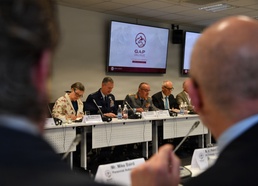
GARMISCH-PARTENKIRCHEN, Germany (June 12, 2026) — As NATO Allies and partners undertake historic commitments to strengthen their defense capabilities, senior military leaders gathered with government and industry representatives at the George C. Marshall European Center for Security Studies June 11–12 to address a central task for the transatlantic community: translating spending commitments into credible military capability and deterrence.
Convened by German Army Gen. Carsten Breuer, German Chief of Defence, and U.S. Air Force Gen. Alexus Grynkewich, commander of U.S. European Command and NATO Supreme Allied Commander Europe, the German-American Partnership (GAP) Dialogue brought together senior private-sector stakeholders to examine how nations and industry can better synchronize operational requirements, production capacity, procurement systems, and advance interoperability in support of collective defense readiness.
“Europe has both the responsibility and the opportunity to take a leading role in its conventional defense,” said Breuer. “That requires industry to understand military requirements, militaries to understand industrial realities, and governments to create the conditions for both to succeed. Forums like this help bring those perspectives together.”
The dialogue provided a unique forum for military leaders to engage directly with senior industry executives responsible for delivering critical capabilities, while industry participants gained deeper insight into the operational demands shaping defense requirements across the Alliance.
“Given today’s dynamic global security environment and the potential for multiple simultaneous contingencies around the globe, the need to quickly move to a ‘NATO 3.0’ with a stronger Europe in a stronger NATO has become obvious to everyone,” Grynkewich said. “But what does that practically mean for government and industry? In the near term, we need to focus on fielding and scaling quickly, and on our ability to sustain a broad range of capabilities, including long-range fires, drones, and counter-drone systems, over time. In the mid-to-long term, we also must ensure we focus on developing the next generation of platforms and capabilities, given the rapid pace of technological change. We can only do this if we work together to understand and remove barriers and improve cooperation across governments and industries.”
Discussions focused on bridging gaps between defense planning and industrial production by improving coordination across governments, militaries, and private-sector partners. Participants emphasized the importance of accelerating procurement processes, strengthening supply chains, and enhancing interoperability to meet evolving security challenges.
The event also underscored the Marshall Center’s key role as a transatlantic convening platform for its Transatlantic Industrial Readiness Program initiative.
“At a time when deterrence is constrained less by funding than by industrial capacity and time, the Marshall Center’s role as a trusted German-American convening platform is critical,” said Barre Seguin, Marshall Center director. “By bringing military, government, and industry leaders together, the GAP Dialogue helps drive the alignment needed to move from discussion to action at speed and scale.”
The GAP Dialogue reflects ongoing transatlantic efforts to ensure that strategic commitments are matched by tangible capabilities, reinforcing collective defense and long-term security across the Euro-Atlantic region.
The day before the GAP Dialogue, Breur and Grynkewich discussed similar themes with aerospace and defense leaders during https://www.atlantik-bruecke.org/en/2029-is-the-red-line-saceur-talk-on-europes-defense-buildup/ at the ILA aerospace show in Berlin. Other defense and military leaders – on both sides of the Atlantic – are engaged in similar conversations, which are important as the NATO Summit in Ankara approaches, but more important for both transatlantic and global security.