Naval Air Station North Island, San Diego, Calif.--When most people think about military communications, they picture radios, computers and internet connections. What they don’t see is the work required to make those systems function in places where the infrastructure doesn’t already exist.
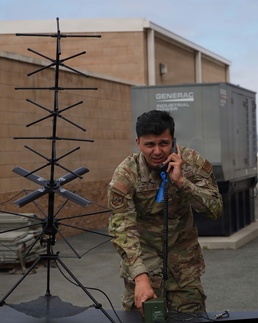
Airmen from the 146th Communications Squadron recently put those skills to the test while supporting a U.S. Navy Carrier Strike Group 15 training exercise at Naval Air Station North Island in Coronado, California. The team deployed satellite communications equipment and networking capabilities to help support the exercise while working alongside Navy personnel to improve communication between the two services.
“At home station, we’re mostly supporting enterprise infrastructure,” said Staff Sgt. Marco Vasquez, a cyber security specialist assigned to the 146th Communications Flight. “This is more agile. We’re setting up satellites, moving equipment around, troubleshooting and making sure we’re connected to the right satellite so everything works.”
The training allowed Airmen to practice a different side of their mission than what they typically perform at Channel Islands Air National Guard Station. Rather than maintaining established networks, the team was responsible for building communications capabilities from the ground up and ensuring users could access the resources they needed to support the exercise.
“We set up a satellite, established connectivity and provided communications capabilities for them to use,” Vasquez said. “If we were somewhere without internet, we could provide that capability if it was needed.”
Operating in a field environment also required Airmen to adapt to conditions and equipment outside of their normal day-to-day responsibilities. The mission gave the team an opportunity to sharpen expeditionary skills, troubleshoot problems in real time and gain experience supporting a customer from another service. In addition to establishing communications, the exercise gave Airmen and Sailors an opportunity to work through challenges that can arise when different services need to communicate using different systems and procedures.
“It’s important for all the branches to be able to communicate together,” said Staff Sgt. Christopher Jolly, a cyber systems technician assigned to the 146th Communications Squadron. “The Air Force has no trouble communicating with itself, and the Navy has no trouble communicating with itself, but integrating the two together is important so we can all come together for whatever mission may arise in the future.”
One focus of the training involved identifying issues with radio communications and working collaboratively to find solutions. According to Jolly, the process required close coordination between the U.S. Air Force and the U.S. Navy personnel to better understand how each service operates and how their systems can work together during future missions.
“We’re meeting with the Navy’s radio personnel and our personnel to come up with ways to better integrate Air Force and Navy communications,” Jolly said.
While not every challenge was solved immediately, the exercise provided valuable lessons that can be applied during future training events and real-world operations. For the Airmen involved, the experience reinforced the importance of flexibility, communication and teamwork when operating alongside partner organizations. For the communications flight, the training provided an opportunity to apply technical skills in a joint environment while strengthening relationships with a sister service.
Maj. Joshua Cochran, commander of the 146th Communications Flight, said opportunities to train alongside other branches help Airmen develop expeditionary communications skills while improving interoperability across the joint force. He said the Airmen’s performance during the exercise demonstrated the adaptability and technical expertise required to support missions outside of home station.
Exercises like the one at Naval Air Station North Island allow communications Airmen to move beyond the classroom and apply their knowledge in realistic scenarios. By working through technical challenges and supporting mission partners in the field, Airmen gain experience that helps prepare them for future operations wherever their skills may be needed.
As military operations continue to rely on coordination between multiple services, exercises like these help communications Airmen prepare to provide reliable connectivity in a variety of environments and mission sets.