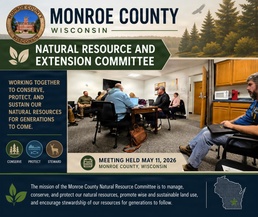
Fort McCoy staff provided updates about the installation's natural resources-related efforts May 11 during the May 2026 meeting of the Monroe County (Wis.) Natural Resource and Extension Committee.
The monthly committee includes members Nodji VanWychen, Joey Esterline, Cedric Schnitzler, Doug Rogalla, Todd Sparks, and Paul Zastophil from areas within the county. According to the Monroe County webpage for the committee, the group works to manage, conserve, and protect natural resources while promoting sustainable land use, outdoor recreation, education, and stewardship throughout Monroe County.
As part of Monroe County, Fort McCoy supports the committee through the Fort McCoy Directorate of Public Works Environmental Division Natural Resources Branch (NRB), the Fort McCoy Public Affairs Office, and other installation personnel.
During the May meeting, Fort McCoy representatives reviewed recent accomplishments completed by NRB personnel during April and early May. Updates covered fisheries, forestry, threatened and endangered species management, invasive species control, wildlife management, prescribed burning operations, and conservation partnerships.
Among the accomplishments highlighted during the meeting were several significant fisheries projects.
— NRB fisheries personnel collected water samples during three runoff events, monitored 38 stream thermographs, and collected temperature and dissolved oxygen data on all 10 installation lakes. Dissolved oxygen levels remained at optimal levels following spring ice-out conditions. Fisheries staff also stocked 15,000 rainbow trout into six Fort McCoy lakes and continued spring fish population surveys.
— Fisheries personnel conducted extensive fyke netting surveys on the North Flowage, Suukjak Sep Lake, Swamp Pond, and Big Sandy Lake. Early survey results showed the North Flowage bluegill population estimate was nearly identical to historical averages and included many quality-sized fish. The largemouth bass population estimate was the highest recorded during recent surveys, reflecting strong recruitment over the past several years. Surveys also identified numerous large bluegills in Big Sandy Lake.
— Forestry personnel reported planting 500 trees in the cantonment area in partnership with Child Development Center participants as part of Arbor Day activities. Forestry staff also submitted fiscal year 2027 timber planning documentation, managed three active timber sales, and supported prescribed fire operations that resulted in approximately 5,295 acres being burned, including acreage within impact areas.
— In threatened and endangered species management, NRB personnel continued extensive monitoring and conservation efforts. Staff completed 20 Blanding's turtle surveys and 15 bullsnake surveys, capturing and processing several animals as part of ongoing population monitoring efforts. Personnel also conducted biweekly telemetry tracking on Blanding’s turtles, wood turtles, and bullsnakes while monitoring eagle and osprey nests across the installation. During nest checks, staff observed activity in a newly identified eagle nest near the North Flowage and continued monitoring active osprey nesting sites.
— NRB personnel also maintained acoustic bat detectors, conducted frosted elfin butterfly monitoring, and updated wildlife observations within the installation's geographic information system database.
— Invasive species management personnel treated nearly 20 acres for invasive vegetation, including garlic mustard and autumn olive. Staff also surveyed more than 68 acres while balancing invasive species management efforts with an active prescribed burning season. Despite challenging weather conditions and limited staffing, personnel supported six prescribed burns during the reporting period and completed environmental reviews for two projects. Staff additionally partnered with fisheries personnel and members of the Monroe County Invasive Species Working Group to review stream improvement projects following invasive species removal efforts.
— Wildlife management personnel continued updating Fort McCoy’s hunting, fishing, and trapping regulations while coordinating with installation organizations and working groups. Staff also managed the installation's spring turkey season, issuing all 460 available permits. Through the first three spring hunting periods, hunters harvested 62 turkeys. Wildlife personnel also completed annual wild turkey and ruffed grouse surveys, which showed grouse activity remained similar to previous years while turkey observations and gobbling activity declined compared to 2025 survey results.
— Additionally, wildlife personnel completed the spring prescribed burn season, conducting fuel-reduction burns within the North Impact Area, South Impact Area, selected training ranges, and portions of the railroad corridor. Officials reported the installation's partnership with the U.S. Forest Service successfully supported the burn program during its first season of implementation. Staff also began preparations for summer wildlife surveys and completed professional certification activities related to integrated pest management.
Fort McCoy’s natural resources program supports military readiness while conserving and managing more than 60,000 acres of training lands and natural habitats, Fort McCoy Garrison officials stated. Through ongoing monitoring, habitat management, wildlife conservation, invasive species control, forestry operations, and fisheries management, Fort McCoy continues to balance its training mission with responsible stewardship of the installation's natural resources.
Fort McCoy’s motto beginning in 2026 is “Training the Total Force and Shaping the Future since 1909.” The installation’s mission: “Fort McCoy strengthens Total Force Readiness by serving as a training center, Mobilization Force Generation Installation, and Strategic Support Area enabling warfighter lethality to deploy, fight, and win our nation’s wars.”
And Fort McCoy’s vision is, “To be the premier training center supporting the most capable, combat-ready, and lethal armed forces.”
Located in the heart of the upper Midwest, Fort McCoy is the only U.S. Army installation in Wisconsin. The installation has provided support and facilities for the field and classroom training of more than 100,000 military personnel from all services nearly every year since 1984.
Learn more about Fort McCoy online athttps://home.army.mil/mccoy, on Facebook by searching “ftmccoy,” on Flickr at https://www.flickr.com/photos/fortmccoywi, and on X (formerly Twitter) by searching “usagmccoy.” Also try downloading the My Army Post app to your smartphone and set “Fort McCoy” or another installation as your preferred base.
Fort McCoy is also part of Army’s Installation Management Command where “We Are The Army’s Home.”
(The Fort McCoy Directorate of Public Works Environmental Division Natural Resources Branch contributed to this article.)