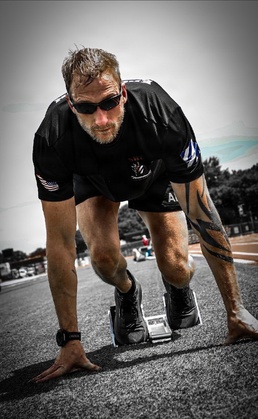
SAN ANTONIO, Texas – June 11, 2026 – As Team Army prepares to compete in the 2026 Warrior Games, many athletes say representing the Army carries a deeper meaning than competition alone.
For Chief Warrant Officer 3 Cody Edgerton, a first-time Warrior Games athlete assigned to Fort Stewart, Georgia, the Team Army uniform represents far more than an opportunity to compete. It represents a lifetime of service, sacrifice and the people who stood beside him through some of life's most difficult moments. Seeing "Army" across his chest, he said, serves as a powerful reminder of the community that has shaped him over the past two decades. "The Army as a whole is a family," he said. "It's a way of life. It changes your way of life."
Following a series of significant health challenges, Edgerton was introduced to adaptive sports through the Army Recovery Care Program, where he discovered new ways to challenge himself physically while rebuilding confidence in his recovery. From wheelchair basketball and seated volleyball to rowing, cycling and track and field, he embraced opportunities that reminded him he was capable of more than he once believed.
"The Army, ARCP and SRU showed me, 'You're not done,'" Edgerton said. "Adaptive sports became something I could incorporate into my recovery."
The Warrior Games, he said, represent far more than athletic competition. They reflect resilience, connection and the support found throughout the recovery community. When asked who he represents at the Warrior Games, Edgerton doesn't hesitate to name his 9-year-old daughter, Lyla, and her mother, Ashlynn Edgerton. After reflecting throughout Warrior Games week, he realized his answer had grown more complicated.
For most of his life, Edgerton said he would've told anyone he was competing for everyone except himself. He was comfortable focusing on fellow Soldiers, family members and the friends he'd lost along the way. Those people remain at the heart of his journey, but for the first time, he's allowing himself to acknowledge his own perseverance. "I've always felt more comfortable focusing on other people," Edgerton said. "But for the first time in my life, I'm also representing myself."
That realization, he admits, felt unfamiliar and even uncomfortable. To him, however, it isn't about selfishness. It's about recognizing that showing himself the same grace and support he has always given others is part of his recovery and an important step toward continuing forward.
After everything he's endured through military service, injuries, cancer and recovery, Edgerton says simply standing in a Team Army uniform is proof that his story didn't end where he once feared it would.
He also carries with him the influence of the leaders, mentors and fellow Soldiers who helped shape him throughout his career, describing them as more than supervisors or commanders. They became examples of integrity, service and character whose influence continues to guide him today.
Most importantly, Edgerton hopes his journey serves as a reminder that difficult beginnings don't have to determine someone's future.
"More than anything," he said, "I'm representing possibility. The idea that no matter how dark things become, your story doesn't have to end there."
As competition approaches, Edgerton believes the true meaning of this year's Warrior Games theme, "Unity," extends far beyond the field of play. To him, it's found in the quiet moments between athletes, coaches and staff members, in the shared understanding of recovery and in the unwavering support that exists throughout the Team Army community.
"You don't know what Warrior Games does to you until you're there," Edgerton said. "Even as a participant watching, it’s going to get emotional. That's unity. That's what this world needs."