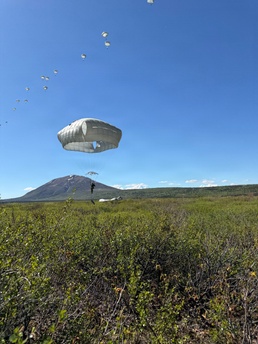
More than 360 paratroopers from the 3rd Battalion, 509th Parachute Infantry Regiment, 2nd Brigade Combat Team (Airborne), 11th Airborne Division, showcased the Army’s Arctic readiness and joint warfighting capability during RED FLAG-Alaska 26-2, June 3-5, 2026.
RED FLAG-Alaska 26-2 brought together U.S. Army, Air Force, and allied partners from the United Kingdom, Canada, and New Zealand to rehearse and execute complex Joint Forcible Entry Operations (JFEO) in the Joint Pacific Alaska Range Complex (JPARC), the largest instrumented air, ground, and electronic combat training range in the United States.
“Our battalion conducted a 72-hour mission to seize Donnelly Field landing strip by airborne assault, expand the lodgment through rotary wing air assault, and secure objectives in the Combined Arms Collective Training Facility,” said Lt. Col. Brandon Davis, commander of 3-509th Infantry (Airborne). “This was a true test of our ability to plan, synchronize, and execute large-scale combat operations in the Arctic alongside our joint and allied partners.”
The operation began with a multi-national airborne assault, as paratroopers and supplies flew from Joint Base Elmendorf-Richardson to Donnelly Field aboard U.S., U.K., Canadian, and New Zealand aircraft, including C-130 Hercules, a C-17 Globemaster III, and an Airbus A400M Atlas. The final approach to the drop zone featured aggressive low-level evasive maneuvers. Scouts infiltrated by helicopter, and Alpha Company led the first air assault, followed by Bravo and Charlie Companies.
Joint integration was central to the exercise, with U.S. Air Force and allied partner aircraft providing lift support for the airborne assault, while Army rotary wing assets from the 1-52nd General Support Aviation Battalion, part of the 11th Airborne Division’s Arctic Aviation Command, delivered critical support for follow-on air assault operations. Brigade and division command and control elements worked closely with Air Force partners to synchronize airspace and operations, leveraging new equipment such as Cold Weather All-Terrain Vehicles (CATVs).
“Red Flag is unique because it allows us to put all the pieces of the joint fight together; from planning and winning the air war, to conducting the airborne assault, expanding the lodgment, and exfiltrating forces back to JBER,” Davis said. “JPARC gives us the space and realism to synchronize rotary, fixed, and unmanned aircraft at a scale you can’t find anywhere else in the country.”
After securing their objectives, squads trained on urban operations, including building clearance, team movement, and ambushes. The battalion also practiced reconnaissance handovers, mortar firing points, and door bundle operations with 81mm mortars. Sustainment and backhaul of equipment were provided by a ground assault convoy package.
The battalion built upon lessons learned from 1st Brigade and Arctic Aviation Command, who have pioneered cold-weather air assault operations in Alaska. Integration with the landing zone control team and pathfinders, as well as working with BCT staff and Air Force partners, was critical to the success of the operation.
“This exercise is directly relevant to what we could face in real-world operations,” Davis said. “We’re building out our air assault capability, rehearsing how to secure key terrain, bring in long-range fires, and rapidly maneuver around the Pacific and Arctic. Working alongside our Air Force and allied partners, and fighting against a tough opposing force, makes us more ready and lethal.”
RED FLAG-Alaska 26-2 provided a unique opportunity for the 11th Airborne Division to train as a joint force, integrating all phases of the JFEO from planning to safe return of the ground force from the objective. The exercise design facilitated both Army and Air Force training objectives, and allowed for close coordination with allied partners.
“Red Flag is one of the most well-resourced exercises we participate in, and it’s critical for the 11th Airborne Division and the Army,” Davis said. “It’s about readiness, lethality, and the ability to fight and win as a joint force in the world’s harshest environments.”