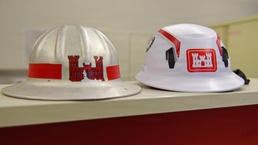
NASHVILLE, Tenn. (June 11, 2026) – In the high-stakes environments of hydropower plants and active construction sites, safety is not optional. By donning hard hats and securing chin straps, U.S. Army Corps of Engineers employees actively mitigate risk, maintaining a culture where protection is part of the mission.
“Head protection has benefited from many technological advances over the past century, and the Corps of Engineers has made today’s modern hard hat part of our safety culture” said Paul Buress, chief of Safety for the USACE Nashville District.
As part of Hard Hat Awareness Week June 8-14, Burress explained that hard hats have evolved over the past century. In 1919 steamed canvas produced hard hats inspired by the “doughboy” helmets of World War I were produced to protect workers.
“By the 1930s, designs shifted toward aluminum and Bakelite — but this progress came with a hidden cost. The conductivity made them dangerous near electrical hazards,” Burress explained, noting that this prompted another vital shift toward the safer, non-conductive materials relied upon on today..
Hard hats transitioned in the 1950s to non-conductive and lighter materials such as fiberglass, polyethylene, and other suitable plastics. The most recent evolution for USACE in 2023 promoted chin straps to prevent injuries due to hard hats falling off during slips, trips and falls, and the use of multi-layer materials that mitigate impacts.
These advanced hard hats feature smart technology, such as RFID chips or QR codes embedded directly into the shell of hard hats.
“This allows employees to see the manufacturer’s instructions on their smart phones and although USACE doesn’t currently recommend this for our workforce, critical medical information (personally identifiable information) that may be important to first responders during emergencies can also be securely uploaded such as allergies and blood type, and emergency contacts.” Burress said. “This can be very helpful for large transient workforces and in instances where communication may be a challenge.”
Corps employees build, operate, and maintain critical infrastructure that keeps the nation secure and the economy moving. But the most valuable asset is not the concrete of locks, steel in dams, or depth of navigation channels; it is people. When the workforce puts on the new Type II safety helmets with integrated chin straps, it is more than just a regulatory update.
“It is a commitment to ensure that every single one of us goes home safely to our families at the end of every shift,” Burress noted about why employees should always wear hard hats. “Your safety helmet is your personal shield. Wear it proudly, secure the chin strap, and look out for your teammates on the jobsite.”
Burress recommends that hard hats, helmet shells and suspension system should be visually inspected daily for cracks, dents, chalking, or fading, which indicates UV degradation from sun exposure. They should be replaced every five years, although some are rated up to 10 years. Refer to the manufacturer’s guidance, labels, and stamps found inside the hard hat to include specific make, and model, when caring for the hard hat. he added.
Maintenance and Care Guidelines
Stickers are ok as long as they don’t interfere with standard markings or the ability to inspect the headgear. Military ranks and name labels are encouraged and should be placed above the USACE Castle logo on the front of the USACE hard hat.
The white USACE hard hat with red stripes and castle logo is very distinctive and recognizable on any construction or dam project site.
Beyond the branding, these modern helmets are feats of engineering. By utilizing advanced suspension systems to absorb kinetic energy and rigid shells to deflect falling hazards, they provide a vital shield for our most valuable asset: our people. Hard Hat Awareness Week serves as a critical reminder of this commitment — not just to a piece of equipment, but to the safety and well-being of the entire USACE team.
“During emergency operations, disaster responses, or at large civil works projects, it is vital that local partners, contractors, and the public can instantly identify USACE employees. This distinct branding fosters trust establishes a clear chain of safety command, and ensures our personnel are easily recognizable and locatable in chaotic conditions,” Burress said.
Modern hard hats worn by USACE employees utilize advanced structural engineering to protect the brain, skull, and cervical spine. Rather than transmitting a blow directly to the skull, the internal suspension stretches and deforms, absorbing the kinetic energy and distributes the force evenly. The rigid shell prevents sharp, heavy, or high-velocity objects such as falling bolts or tools from piercing the helmet.
Hard Hat Awareness Weekis a week of activities designed to encourage best practice around safety equipment, awareness of head injuries, and educate on real-life impact scenarios, rotational injuries and how they occur. For more information about Hard Hat Awareness Week, go to http://www.hardhatawarenessweek.com.
The public can obtain news, updates and information from the U.S. Army Corps of Engineers Nashville District on the district’s website athttps://www.lrd.usace.army.mil/About/Districts/Nashville-District/, on Facebook athttp://www.facebook.com/nashvillecorpsand on X (formerly Twitter) athttp://www.x.com/nashvillecorps. Follow us on LinkedIn for the latest Nashville District employment and contracting opportunities athttps://www.linkedin.com/company/u-s-army-corps-of-engineers-nashville-district.