The yellow pennant with a blue anchor symbol flying below the American flag on the Naval Surface Warfare Center, Port Hueneme Division’s (NSWC PHD) campus might be small, but it’s significance for the command is mighty.
The pennant represents the federal government’s Retention Excellence Award (REA), which NSWC PHD has earned for exceeding the benchmarks of sailor reenlistments in fiscal 2024 and 2025, explained Chief Logistics Specialist Andy Coleman, who serves as the NSWC PHD military affairs command career counselor.
“The point of the REA is to recognize Navy commands that support the fleet by leveraging all force management tools to attract, develop and retain active duty and reserve talent,” Coleman said. “The REA is a big accomplishment for any command across the fleet.”
Of the three Naval Sea Systems Command (NAVSEA) warfare centers that earned the REA for fiscal 2025, only NSWC PHD earned it for two consecutive years of meeting or exceeding the benchmarks.
NAVSEA Commander Vice Adm. James Downey emailed the Navy activities that earned the REA last month, congratulating their “deckplate leadership, career counselors, and all members of your career development teams for their outstanding work.”
To earn the award, a command must meet a predetermined benchmark set by the Navy over the course of the reporting fiscal year. Percentages are calculated based on total number of enlisted personnel attached to the command and the number of personnel who are retained by either reenlistment or extension. Metrics are tracked quarterly to determine eligibility for the award and compiled at the end of the fiscal year.
According to Coleman, the benchmarks are broken down into percentages by three zones, which represent the length of time for an enlisted member’s service. If a Navy activity doesn’t have any qualifying members who fit a certain zone, then that zone will be automatically set to the minimum required benchmark — rather than 0% — but the activity can still earn the REA as long as it has qualifying transactions in other zones.
“Commands must have a minimum of one zone with qualifying transactions,” Coleman said. “The criteria states that the benchmark must be met for at least two quarters, or the fiscal year overall.”
Using these criteria, the command met its benchmarks for at least two quarters in both fiscal 2024 and 2025, thereby earning the REA and the honor to fly the yellow-and-blue pennant until the numbers come out for fiscal 2026.
Senior Chief Fire Controlman (Aegis) Autumn Johnson served as the command’s senior enlisted leader for fiscal 2024 and 2025.
“This recognition means far more than numbers; it speaks to the heart of who we are as a command,” she said. “Our sailors have built something special here, a place where people genuinely look out for each other, support and celebrate their peers’ successes, and stand together through every challenge. That sense of family, combined with an unwavering commitment to the mission, is what inspires our sailors to keep serving and growing in our Navy.
“Earning the Retention Excellence Award for two consecutive years is a reflection of that bond, and I’m incredibly proud of the trust and dedication that our team shows every day,” she added.
Johnson gave high praise to Coleman for the command’s reenlistment success in fiscal 2025.
“He is the reason we were able to get [the REA],” she said.
Incentives and support
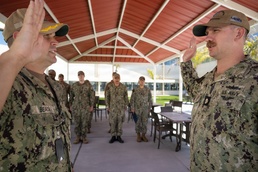
During his time as military affairs command career counselor, Coleman has shepherded six sailors through reenlistment. While most of the sailors who reenlisted in fiscal 2024 and 2025 have since moved on to their next duty assignments, Fire Controlman (Aegis) 1st Class Marcel Gibbons, who reenlisted in July, is still at NSWC PHD for another two years.
Gibbons enlisted in the Navy in October 2016 and joined the command last February. He works with power conversion systems, participating in Combat Systems Assessment Team events and ordnance alteration installations as needed, he said.
“My goal has been to do 20 years and retire,” Gibbons said. “LSC Coleman helped me navigate the reenlistment date around my schedule and also helped me understand the Selective Reenlistment Bonus (SRB) program.”
Coleman said that some sailors do qualify for the SRB, and that the amount can vary based on several factors, including the sailor’s rate and how many years enlisted, with most bonuses having a cap of between $20,000 and $75,000.
“I did receive a bonus, and it was icing on the cake,” Gibbons said.
In 2024, the Navy pledged to increase retention bonuses tosurface warfare officers, offering up to $150,000 spread out over several years for officers to stay in service. This was part of the Navy’s overall increase in both enlistment and retention bonuses from 2022 to 2024, according to news stories.
However, most of NSWC PHD’s military personnel are enlisted rates of either fire controlman or fire controlman (Aegis), Coleman said.
Understanding what SRB they may qualify for is just one of the services Coleman provides to sailors in his role as command career counselor.
“I sit down with the sailors and try to figure what their goals are, what situation they are in, and give them all the options available to them,” Coleman said. “In my counseling sessions I don’t ‘sell’ the Navy to the sailor. My goal as a counselor is to make sure sailors have all the information they need to make the best and most informed decision.”
Coleman also helps sailors collect the documents needed for the reenlistment package and ensure all paperwork and entitlements are processed correctly.
Coleman added that while career counselors are essentially built-in mentors and can influence a sailor’s decision to stay in or separate, ultimately it is the sailor’s experience with their local leadership that can have the most impact.
“Great leaders ensure sailors remain battle ready, trained and resilient, and inspire them to continue service in the Navy as a career,” he said.