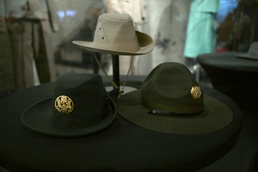
Step inside the Basic Combat Training Museum on any given day, and you’ll feel a buzz of energy. Yesterday, on June 10, that buzz was a roar. As Fort Jackson celebrated its 109th birthday during Victory Week, the museum welcomed a record wave of visitors, from proud families on Family Day to a sharp group of Junior ROTC students.
For many, it’s a chance to see the gear, the uniforms, and the displays that bring a Soldier’s first grueling weeks to life. But according to the museum’s director, Henry Howe, the building holds more than just artifacts, it holds the very soul of Fort Jackson.
“We are in touch with the history of the Army,” Howe said, standing among exhibits that have welcomed nearly 100,000 visitors in a single year. “We’re in touch with the history of Fort Jackson itself.”
He and fellow curator Steve Noonan see themselves as guardians of a story much bigger than most people realize. Today, Fort Jackson is known as the place where over half of the Army’s Soldiers are forged. But look closer at the stories housed in the museum, and you’ll discover forgotten chapters.
“People forget that we were once upon a time an infantry training base,” Howe explained. “People forget that we were an artillery training base. Our history is pretty deep and pretty broad.” How deep? Imagine a Fort Jackson so vast it stretched nearly 55,000 acres from what is now Decker Boulevard all the way to Columbia’s Five Points. During World War II, it was a sprawling city of its own, home to remnants of six divisions and housing up to 130,000 soldiers. From 1944 to 1946, it even held a camp for German prisoners of war. “We are an integral part of Columbia,” Noonan added, reflecting on a bond that dates all the way back to 1917. “When the city leaders and citizens rallied together to bring Camp Jackson here for World War I, they essentially intertwined our destinies. For over a century, Soldiers have trained in these pines, shopped in local businesses, attended local churches, and so often returned to make Columbia their forever home. The post and the city truly grew up together. You just can’t tell the story of one without the other.” The museum, which began as little more than a hallway collection in 1972, is now a treasure chest of these incredible, shared histories. But Howe and Noonan aren’t just collecting old items. They are on a mission to find objects with a direct, personal link to the post, a quality they call “provenance.” “We can’t collect everything,” Howe said. They want key items that tell a specific Fort Jackson story. Right now, Noonan is hunting for an M249 Squad Automatic Weapon. But not just any M249. He wants one that was actually fired on the ranges here, a weapon whose thunder echoed through the pines during a basic training exercise. That specific connection, Noonan says, is what matters. It’s the difference between a random artifact and a true piece of living history. This dedication to storytelling is what makes the museum so special. It’s not just a place for looking; it’s a place for connecting. “When the private graduates, his Family comes in, and it’s a chance for him to talk about what he did,” Howe said. A simple first-aid kit in a display case becomes a bridge. “‘This is what the first-aid kit does,’” the new soldier can tell his family. “‘This is what I use, and here’s how I used it.’” In the entire Army, this is the one museum dedicated to the profound journey of “soldierization,” the transformation of a civilian into a Soldier. It’s a story of challenge, change, courage, and community, and it’s waiting for you to discover it.