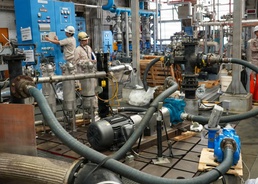
YOKOSUKA, Japan— The U.S. Navy has taken a major step toward increasing the performance and reliability of the surface fleet and saving money at its ship repair facility in Japan. Technicians and engineers at U.S. Naval Ship Repair Facility and Japan Regional Maintenance Center (SRF-JRMC) have built and tested a main reduction gear (MRG) flushing rig, enabling the facility to organically and cost-effectively maintain surface ships.
Historically, regional maintenance centers have relied on private contractors for flushing jobs. To improve efficiency and reduce costs, SRF-JRMC collaborated with engineers from Southwest Regional Maintenance Center (SWRMC) to design and build an in-house mobile flushing rig using Navy resources exclusively.
The main reduction gear is the heart of a ship's propulsion system, operating under precise tolerances. Even microscopic particles of dust or metal can cause significant failures in the gears or bearings. Regular flushing keeps these systems clean and helps prevent costly breakdowns at sea.
Traditionally, regional maintenance centers have relied on private contractors for flushing jobs. To improve efficiency and reduce costs, SRF-JRMC collaborated with engineers from the Southwest Regional Maintenance Center (SWRMC) to design and build an in-house mobile flushing rig using Navy resources exclusively.
“By operating our own flushing rig, SRF-JRMC is increasing its organic capability, improving ship readiness, and setting an example of innovation across the fleet,” said Pierce Bellaire, process manager for SRF-JRMC’s production department. “This accomplishment shows that SRF-JRMC truly embodies our motto “Nan Demo Dekimasu,” translated to "We Can Do Anything."
The flushing rig is designed to utilize the ship’s oil sump to recirculate 2,000 gallons of clean oil through the MRG lube oil piping system at flowrates in excess of 300 gallons per minute. The flush is accomplished by installing flanges throughout the system in order to correctly target piping runs and protect critical components.
It consists of 5 main components: a main circulation pump, main filtration complex, in-line heaters, high-purity filtration complex, and distribution manifolds to direct flow to the correct system locations. The circulation pump pushes oil first through the main filtration complex, where 40-micron filters remove impurities. The in-line heaters bring the oil up to flushing temperatures of 165 degrees Fahrenheit before being sent to shipboard piping through the distribution manifolds, which allow the flush to be directed to specific pipes and maximize flow. The high-purity filtration system constantly takes flow from the oil supply piping, filtering at 1 micron to remove particulate and water, then directing clean oil back to the sump. Pressure gages, thermometers, and sample ports throughout the rig allow system conditions to be continuously monitored. The entire apparatus is connected in a continuous loop with high-pressure hoses, custom flanges, and specialized adaptors to the main reduction gear manifold.
The team plans to use the rig on an Arleigh Burke-class guided-missile destroyer next. Because the rig is portable, it can support Navy ships throughout the Pacific. The project shows how collaboration between dedicated Navy commands delivers practical solutions that keep the fleet mission ready and on schedule.
For over 75 years, SRF-JRMC has been the linchpin of U.S. Naval operations in the Indo-Asia-Pacific region by providing intermediate-level and depot-level repair and maintenance for the ships of the U.S. Seventh Fleet.