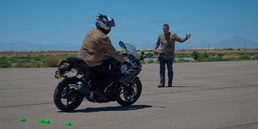
HOLLOMAN AIR FORCE BASE, N.M. — Holloman Air Force Base hosted the Department of the Air Force’s Rider Mentor Program Trainer course May 19-20, 2026, becoming the second installation in the Air Force to offer the new motorcycle mentorship training initiative designed to increase rider safety and expand training accessibility across the force.
The program, developed jointly by the Motorcycle Safety Foundation and the Department of War, was created to supplement existing motorcycle safety training requirements outlined in Department of Defense Instruction 6055.04 and Department of the Air Force Instruction 91-207. The program provides an alternative method for Airmen and Guardians to complete Level II and III motorcycle refresher and sustainment training.
Unlike traditional motorcycle training programs, the program allows trained mentors to conduct instruction at locations below the wing level, increasing flexibility and accessibility for riders. Mentors can be any qualified motorcycle rider who completes the trainer course.
According to program officials, approximately 21% of DAF motorcycle riders are overdue on required training, largely due to limited training availability at some installations. While some bases maintain self-sustaining motorcycle safety programs, others have limited or no available training opportunities.
“This program will create more opportunities to train not only at Holloman, but also across the Air Force and Space Force rider communities,” said John E. McLaughlin, DAF motorcycle safety program manager. “The riding community will be able to create their own training classes and no longer be limited by previous restrictions such as requiring certified training sites.”
The program does not replace existing Motorcycle Safety Foundation courses, but instead serves as an additional option for riders to fulfill required sustainment training. Officials say the streamlined structure allows mentors to be trained in approximately two days, compared to the traditional 9-to-10-day MSF Ridercoach certification process.
The flexibility of the program will also allow training to occur in a variety of paved locations held to be suitable by mentors, reducing scheduling delays and increasing opportunities for unit-level instruction with minimal coordination requirements.
Leaders emphasized that the program directly supports mission readiness by reducing overdue training and helping riders develop safer riding habits both on and off duty.
“The impact of losing any Airman or Guardian is a terrible tragedy, and every loss negatively impacts mission capabilities,” said U.S. Air Force Tech. Sgt. Akin R. Hyde, 49th Wing Safety occupational safety technician “Training provides riders with the skills and decision-making abilities needed before, during and after operating a motorcycle, helping reduce mishaps and improving overall readiness.”
Officials hope the program will help close training gaps across the department while fostering a stronger culture of motorcycle safety throughout the riding community.
“At work every day, Airmen and Guardians train to survive the fight and return home to their loved ones,” said McLaughlin. “We want every rider to apply that same mentality to motorcycling, train to survive the ride so they can return home safely.”