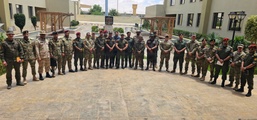
VICENZA, Italy - Soldiers assigned to Civil Affairs Team Libya, Bravo Company, Civil Affairs Battalion, U.S. Army Southern European Task Force, Africa (SETAF-AF) conducted a military-to-military subject matter expert exchange with representatives of the Libyan Armed Forces in Benghazi, Libya, May 19-22, 2026.
This exchange was the first of what CA Team Libya has planned to be a series of “M2M” exchanges with partner forces, with planning underway for an exchange once a moth throughout the year.
Since the fall of Muammar Qaddafi in 2011, Libya has experienced vast security improvements, according to U.S. Army Maj. Miles Dunning, team lead for CA Team Libya and Bravo Company commander.
Twenty-one military officers, ranging from senior company-grade (captain) to field-grade status (colonel), represented the Libyan Armed Forces. Dunning noted that the partner forces seemed interested in making progress toward a stronger, more stable country.
“They get along together very well from what we’ve seen,” Dunning said. “Both parties are amenable to a lasting peace and are eager to work with each other to continue these exchanges in the future. From what we observed, both partner forces were very cordial.”
This event also marked the first time a SETAF-AF element has conducted an exchange with partner forces in Libya. Dunning emphasized that it represented a pivotal step in building relationships with the military forces of the U.S. and Libya.
“It is specifically SETAF-AF that has been tasked to do these military-to-military exchanges with Libyan partners,” Dunning said. “We are the only conventional U.S. Army force that has a presence in Libya after this engagement.”
As part of the U.S. contribution to the knowledge exchange, the civil affair team discussed how the U.S. Army conducts combined arms operations. This conversation went on to include U.S. warfighting functions, the Military Decision-Making Process, troop leading procedures and the operations order.
During a tabletop exercise that was the exchange’s culminating event, partner forces received a scenario in which they were operating in a fictitious country, and they had to complete a road-clearance operation from one village to another. Given specific resources to complete this notional task, representatives from both partner forces described how they would accomplish the mission.
“Insights [from this exchange] will enable successful rapport building between the U.S. and both Libyan partner forces,” Dunning said. “SMEEs offer a distinct opportunity to participate in open dialogue. They will set the stage for SETAF-AF’s future M2M operations, increase partner force cooperation and facilitate communication between the LNA and GNU.”
Dunning pointed out that these exchanges “increase our ability to work with a partner force” by providing a better understanding of how they operate. In return, those partner forces receive a better understanding of how U.S. forces operate, which makes for conducting improved combined operations in the future.
“This was a ground-breaking event, and it has been many years in the making with a lot of parties, especially with the Security Cooperation Directorate,” Dunning said. “People have put in hundreds of man hours to make this happen and my team was very lucky to be tasked with this mission. It is the first time a conventional U.S. Army element from any organization has been to Libya in 16 years, so it was a big deal and a big first step in reestablishing a military relationship with Libya.”