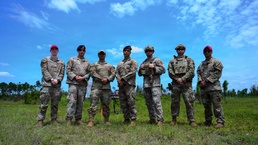
TYNDALL AIR FORCE BASE, Fla. —The 325th Security Forces Squadron showcased its kinetic base defense capabilities to Maj. Gen. Thomas P. Sherman, commander of the Air Force Installation and Mission Support Center, at Tyndall Air Force Base, Florida, June 3, 2026, as part of an ongoing initiative to counter the evolving threat of small unmanned aircraft systems.
During the demonstration, the squadron showcased the effectiveness of the M870 shotgun against simulated sUAS and briefed Sherman on a future training plan to qualify approximately 210 Airmen to employ the weapon and the SMASH 2000 fire control system. Once fully implemented, this program will prepare Airmen to safely and effectively neutralize low-altitude, high-speed aerial targets, establishing a critical point-defense capability for the installation.
"The drone domain is a transformational mechanism that will continue to evolve. It's important that every single defender is capable of integrating current systems and capabilities to deter, detect, delay, deny and defeat. This training will add a defeat capability to our stateside mission set,” said Senior Master Sgt. Reginald Walters, 325th SFS future operations superintendent. "The desired end state of this training is that all defenders get certified. This way, once we dispatch a patrol, they pinpoint the location and engage."
To execute this specialized training, the squadron will operate under Title 10 U.S. Code, Section 130i, which authorizes military installations to mitigate unmanned aircraft threats. The planned live-fire operations will also fully comply with Federal Aviation Administration guidelines within designated airspace.
Under the proposed plan, participating defenders will arrive pre-certified on the M870 shotgun and M4A1 carbine, allowing instructors to bypass basic weapons handling and focus entirely on aerial target engagement. Walters noted that insights from recent global conflicts, including after-action reports from Ukraine, heavily influenced the training's focus on widespread shotgun proficiency.
"The shotgun is another piece of the puzzle for building a reliable, effective point defense capability for the Wing," Walters said. "By adapting our thinking and execution, we are fortifying defense in the air domain on the installation tenfold. Arming defenders with shotguns on every patrol drastically expands our defeat bubble for any type of drone entering our airspace."
Alongside the M870, the new curriculum features the SMASH 2000, an advanced electro-optical fire control system mounted on the M4A1 carbine. The system assists shooters by automatically calculating ballistic solutions and tracking moving targets.
During the practical phase of the new curriculum, shooters will learn to acquire a target and depress the trigger to lock the system onto a simulated drone. This technology allows the weapon to automatically fire only when it guarantees a hit, drastically increasing the first-round strike probability against moving targets.
To manage the active nature of engaging aerial targets, the future training plan mandates strict safety protocols. Certified security forces training and standardization instructors will shadow each shooter, providing direct, over-the-shoulder supervision throughout the exercise.
The live-fire demonstration emphasized the squadron's broader commitment to Airman readiness. Security forces personnel undergo rigorous training to translate classroom theory into tactical execution. By integrating repetitive weapons drills with real-world threat scenarios, leadership ensures every Airman maintains the operational readiness necessary to confront threats at a moment's notice.
"This training helps our Airmen tackle an sUAS threat that is rapidly evolving in real-time," said Tech. Sgt. Nicholas Rhodes, a 325th SFS training and standardization section chief. "It builds the tactical skills that are vital to execute the mission and defend the installation."