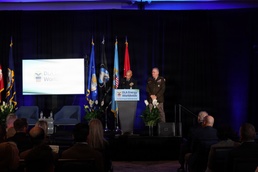
The Defense Logistics Agency Energy brought together military leaders, civilian experts and industry partners to the 2026 DLA Energy Worldwide from April 21–23 at the Hyatt Regency Crystal City in Arlington, Virginia, to tackle the complex challenge of fueling the joint force in an era of contested global logistics.
The event, built around the theme ‘Strategic Energy for Global Advantage,’ drew more than 2,300 attendees. Throughout the three-day event, leaders emphasized the critical role of energy as an enabler of national security and the "lifeblood of the warfighter," as Navy Rear Adm. George Bresnihan, commander of Defense Logistics Agency Energy, noted in his opening remarks.
The event featured a comprehensive slate of workshops covering topics such as petroleum, aerospace energy, facility sustainment, quality control, customer operations and installations. Attendees also engaged with 85 vendors on the exhibit floor and participated in a Small Business Connections session to speak directly with acquisition professionals about emerging technologies, such as nuclear, geothermal and microgrid solutions.
The agency is focusing on three priorities: setting the globe, setting the agency and setting supply chains. Gabby Earhardt, the acquisition executive for Defense Logistics Agency Energy, emphasized to the audience that executing these priorities requires deep, continuous collaboration between the government and the private sector.
Army Lt. Gen. Mark Simerly, director of the Defense Logistics Agency, delivered a keynote address urging a fundamental shift from efficiency-based logistics to a model built for survivability.
"You can't be lethal without logistics," Simerly said. "We must design supply chains for resilience and survivability, not just efficiency. DLA must assume wartime conditions into every level of planning."
To counter what Bresnihan called the "tyranny of distance," the agency is aggressively expanding its global fuel posture. Leaders highlighted a 79-million-gallon defense fuel support point in Australia as a strategic game-changer. Building on that momentum, DLA Energy is establishing a fuel node in Papua New Guinea and plans to develop a 41-million-gallon facility in the Philippines by 2028.
In Europe, DLA is revitalizing a Cold War-era fuel facility in Norway to support operations in the high north, and it has modernized a site in Spain with a new pipeline providing direct access to refinery supply.
A consistent theme during the event was the recognition that fixed fuel sites can be vulnerable. In response, DLA Energy is developing flexible, mobile refueling capabilities, so assets are not concentrated in a single, vulnerable location. Bresnihan cited the repositioning of a commercial tanker to act as a mobile, at-sea fuel depot, delivering more than 10.5 million gallons of fuel to naval forces. In the Red Sea, the agency established long-term fuel barges to create flexible, floating fuel depots.
The vulnerabilities of the commercial supply chain were the focus of a senior leader panel titled "Fueling the Fight: Assuring Bulk Petroleum Dominance in a Contested Environment." The panel, moderated by retired Air Force Lt. Gen. Giovanni Tuck, featured retired Army Maj. Gen. Ed Dorman, Army Brig. Gen. Mark Siekman, and industry executives such as Kollin Fencil and John Brookie. The panelists stressed that the homeland is now a theater of operations. They emphasized the need to share data and war-game scenarios with civilian partners before a crisis occurs to mitigate the risks of drone warfare and global fuel scarcity.
Civilian partnerships are critical for the War Department to execute its logistics mission globally. To ensure a secure and resilient supply chain, developing strong industry partnerships is vital. During the event, agency leaders outlined contributions from industry partners that demonstrated this critical support.
For example, industry partners provided into-truck aviation fuel support and delivered more than 3 million gallons of aviation fuel to military bases in Romania to sustain ongoing operations in Europe. For domestic disaster response, industry partners delivered more than 1.2 million gallons of ground fuel to support federal relief efforts following recent hurricanes.
In the realm of infrastructure, engineering firms executed emergency repairs at a defense fuel support point in Hawaii prior to the defueling of the Red Hill facility. To ensure fuel quality in austere environments, suppliers provided expeditionary analysis kits for field-testing aviation kerosene. Meanwhile, commercial payment services currently process more than 30,000 monthly transactions worldwide to support the military's aviation and maritime fuel purchasing programs in regions where formal contracts may not exist.
To manage this complex global enterprise, DLA is overhauling its internal capabilities with a focus on data and predictive analytics. A key tool being implemented is the Petroleum Logistics Utilization Tool and Optimization system, which fuses global fuel posture with real-time threat intelligence.
Air Force Gen. Randall Reed, commander of United States Transportation Command, served as the keynote speaker on the final day. He highlighted that sharing information across the logistics enterprise is the ultimate key to resilience. He described the partnership between his command and DLA as a combined effort that gives logistics a louder voice in strategic planning.
The agency is also focused on installation energy resilience. A senior leader panel featuring Rebecca Isacowitz, the deputy assistant secretary of war for energy resilience and optimization, alongside service energy leaders such as Mike Zapata for the Air Force, Chris Grisafe for the Navy, and Robert Hughes for the Army, discussed the necessity of targeted microgrids and utility privatization. The panel stressed the importance of preparing military bases to operate independently during commercial blackouts or extreme weather events.
DLA currently serves as the contracting office for a small modular reactor pilot program in Alaska and helped fortify Fort Hood in Texas, which remained fully operational during a historic winter storm while millions of others lost power.
DLA Energy Worldwide is a biennial event, the next event will be in 2028.