NEWPORT NEWS, Va. — The Bob Hope-class MV Roy P. Benavidez , a large, medium-speed roll-on/roll-off ship, returned to its pier in Newport News this week, marking the successful execution of a complex logistical operation that underscores the military's stringent requirements for total cargo accountability. The vessel recently played a pivotal role in U.S. Transportation Command’s exercise TRANSMARINER 26 at the Port of Ponce, Puerto Rico, as part of the broader Exercise Turbo Distribution.
Turbo Distribution is USTRANSCOM’s premier joint-training exercise series designed to test the rapid assessment and port-opening capabilities of the Joint Task Force-Port Opening (JTF-PO) framework.
With expert logistics oversight from the 597th Transportation Brigade, Army Transportation Command (ARTRANS), “Rapid Support” surface warriors on the ground, the vessel’s Ready Reserve crew transported critical cargo to the Port of Gulfport, Mississippi.
There, equipment and supplies were discharged by the 842nd Transportation Battalion, 597th Trans. Bde., Troops and Department of the Army civilians to support waiting forces at Camp Shelby.
Remaining equipment was then re-assigned for onward movement to the Newport News Marine Terminal, the designated break-bulk and roll-on/roll-off facility for the Port of Virginia.
Soldiers and staff from the 841st Transportation Battalion and the 597th were on the ground to provide leadership and operational expertise, ensuring seamless port operations.
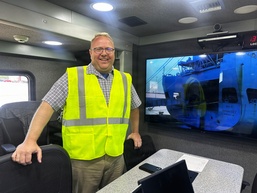
Operating from a mobile command center in Newport News, Andrew Shook, Traffic Management Division chief for the 841st Transportation Battalion in Charleston, South Carolina, led the charge for accuracy across all mobility nodes.
At the core of these massive logistical movements is an uncompromising standard: 100 percent accountability. According to Shook, whose team handles all mobility nodes including rail, trucks, and vessels– maintaining total tracking visibility is vital.
To achieve this flawless standard, Shook and his team utilize the Global Air Transportation Execution System (GATES).
Originally developed by the Air Force’s Air Mobility Command, GATES is a joint-service, web-based system. In port operations, it serves as the authoritative database to manifest, track, and manage military cargo and personnel as they flow through Aerial Ports of Debarkation (APODs) and Seaports of Debarkation (SPODs).
Handled by surface warriors from the Rapid Support team, GATES is used to scan, process, and account for massive roll-on/roll-off cargo unloaded from strategic sealift vessels like the MV Roy P. Benavidez.
"Accountability is key," Shook said. "We use GATES to maintain 100 percent critical accountability across rails, trucks, and vessels because the goal is always 100 percent accuracy."
The recent Turbo exercise movements relied heavily on the JTF-PO framework, a specialized, rapid-response logistics structure designed to quickly open, establish, and operate ports during military contingencies, humanitarian crises, or disaster relief missions, bridging the gap until larger, follow-on theater logistics units arrive.
Because JTF-PO forces must be ready to deploy within 12 hours to austere or contested environments, GATES is heavily stressed during these exercises to simulate contested logistics scenarios and validate Joint Force ability to respond.
During rapid port opening, joint forces must establish GATES connectivity immediately via secure satellite communications to begin receiving strategic flow.
To further test readiness, white-cell evaluators inject simulated disruptions, such as communications blackouts or damaged cargo.
Teams must navigate these obstacles while maintaining GATES tracking accuracy; throughout these challenges, GATES acts as the common language between Joint Force assets, proving that joint systems can synchronize under pressure.
Because the vast majority of military cargo travels via sealift, relying heavily on these port operations, accountability in this phase remains a critical vulnerability.
In what logisticians call "pitch and catch" synchronization, exact coordination is required from origin to destination. If a seaport of embarkation lacks accountability of vehicles and supplies, the deployment schedule fails, delaying the entire force-flow process.
Accurate tracking is necessary to prevent bottlenecks.
Because ports act as waypoints to receive, stage, and integrate forces, mismanaged or unaccounted cargo can cause severe congestion, creating tactical vulnerabilities.
Real-time asset visibility also ensures leaders know exactly what equipment is in transit, allowing them to rapidly reallocate resources as operational needs change.
Ultimately, this strict accountability provides a strategic advantage by allowing the military to "set the theater."
This critical step shapes the operational environment and establishes favorable conditions for deployment, ensuring combat capability is projected to the point of need with absolute precision.
Under the Army of 2030 and Army 2040 modernization strategies, the military is shifting away from building massive, vulnerable "iron mountains" of supplies.
Instead, the force is embracing "data-centric" logistics. In a contested logistics environment—where adversaries will actively target supply lines, ports, and cyber network systems like GATES are no longer just tracking tools; they are warfighting systems.
By feeding real-time asset visibility data into enterprise networks like the Global Combat Support System-Army (GCSS-Army) and Next Generation Command and Control (NGC2) interfaces, GATES helps eliminate blind spots and operational chokepoints.
This modernization allows commanders to leverage predictive logistics, moving supplies at the "speed of need" and ensuring the right equipment reaches our lethal Warfighters before a critical shortage occurs on the battlefield.
Highlighting the vital importance of this logistical transition, Secretary of Defense Pete Hegseth outlined the Department's strategic focus on the logistics survivability concept in modern conflicts during a speech at the National War College.
"We can stay in the fight only as long as our logistics sustain us," Hegseth stated. "Our adversaries know this, and they will attack our supply routes, ports, airfields, depots, and information systems in order to disrupt us. We must be able to fight in this contested environment... Logistics will be prioritized, integrated, and delivered as quickly and as long as our warfighters need it."
Turbo also provided a critical opportunity for third-party oversight and training as Active-Duty Soldiers and DA civilians, acting as subject matter experts, worked alongside reservists to share established procedures.
"We are the experts, we do this every day," Shook explained regarding the importance of this oversight. "We want to make sure these Soldiers learn best practices and lessons we’ve learned and use the same practices we do to obtain that 100 percent accuracy, support our combatant commanders, and assure all equipment makes it to our lethal warfighters.”
Shook emphasized, “100 percent, every time.”
For the Rapid Support team, that level of accountability is more than just a logistical metric; it is a promise to the Warfighter.
As the brigade projects the Force globally in support of large-scale combat operations, maintaining 100 percent visibility from the fort to port– and to the front lines ensures that not a single piece of critical combat equipment is ever left to chance.