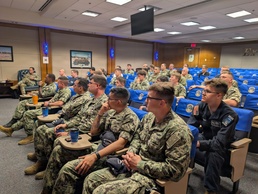
“Who here is afraid of heights,” asked the industry liaison leading submariners across the production floor of a Northrup Grumman facility.
Sailors participating in Portfolio Acquisition Executive (PAE) Strategic Systems Programs (SSP) Reverse Strategic Weapons System (SWS) Week between May 18-22 were met with this question on their first morning of hands-on engagement with industry counterparts as they received an inside look at the production of the Trident II D5 Life Extension (D5LE) missile launch tubes. Peering down into the 35-foot pit in the factory floor that supports the production and testing of the launch tubes, Sailors found themselves face-to-face with the raw parts of the same weapon system they operated while on strategic patrol.
PAE SSP’s Reverse SWS Weeks are educational training opportunities modeled after the regularly occurring SWS Weeks at submarine bases on the East and West Coasts. SWS Weeks bring ballistic missile submarine (SSBN) and guided missile submarine (SSGN) crews, Navy support commands, and industry partners together to share new updates to the weapons system, troubleshoot issues, and forecast upcoming needs for the submarine fleet. Reverse SWS Weeks go a step further by bringing crew members out to PAE SSP’s program management offices (PMO) and detachments – dispersed throughout the nation – providing an exclusive behind-the-scenes look at the weapons system they maintain and operate while on strategic patrol.
PAE SSP’s Reverse SWS Week serves as a powerful realization of the Chief of Naval Operations’ priority to strengthen the vital connection between the foundry and the fleet. By bringing the warfighter directly to the industrial base, PAE SSP ensures that the comprehensive modernization occurring across the entire sea-based leg of the nuclear triad is not just a theoretical concept, but a tangible, collaborative effort between the Navy’s acquisition community and the final end-users.
These training opportunities began in 2022 and were formalized in 2023. This year, Sailors were brought out to PAE SSP’s PMO Flight Systems detachment in Sunnyvale, California (SPF(S)). As a PMO detachment site, SPF(S) serves as SSP’s eyes in the field with the government representatives overseeing design, development, production, installation, and testing for homeland defense and regional strike weapons systems at industry partner sites. SPF(S) is co-located with Northrop Grumman Marine Systems, the industry partner responsible for producing the launch tubes for the nuclear Trident II D5 SWS and the non-nuclear hypersonic Conventional Prompt Strike (CPS) system.
“You never see the crazy level of development, of studies, or everything that goes into the process of launching a missile, because all we submariners see is the missile as a final product,” said Petty Officer 1st Class Jimmie Gilbert, a native of Orlando, Florida, and a missile technician on USS Alaska (SSBN 732). “Learning about the step-by-step building of the missile, of the background studies, the hardening of the components, it’s so mind-blowing and it really puts an emphasis on how important strategic deterrence is to the nation.”
At this year’s Reverse SWS Week, Sailors discussed the needs, challenges, and opportunities related to the Trident II D5LE system deployed on today’s Ohio-class SSBNs and engaged with members of the future Columbia-class USS District of Columbia’s pre-commissioning unit (PCU).
Sailors with PCU District of Columbia are tasked with moving the first-in-class Columbia-class SSBN toward its operational state.
“This consists of a lot of training, particularly for USS District of Columbia given that she is a brand new first in class submarine” said Petty Officer 1st Class Austin Baker, a native of Lake Forest Park, Washington, and the missile division lead petty officer for PCU Columbia.
A key aspect of building useful and sustainable training for PCU District of Columbia, including training that can be used as a baseline for PCUs for follow-on Columbia-class SSBNs, is getting ground-truth from the partners involved in the design, development, and production of the strategic weapons system and weapons system integration components that will be deployed on the Columbia-class.
“I’m really interested in getting that direct interface...” said Senior Chief Adrian Rowe, a native of King William, Virginia, the SWS master chief for PCU District of Columbia. Being able to talk directly to the people who are developing the systems and proofing the technology – I think it puts the pieces in order and helps us to have a fuller understanding of what we are doing.”
PAE SSP’s Reverse SWS Week gave Baker and Rowe the opportunity to have in-depth conversations with the industry partners that are leading the technology upgrades and process improvements that will be incorporated into USS District of Columbia. Their hands-on interactions on the production-floor gave the PCU District of Columbia representatives insight into opportunities for how certain functions on the future SSBN class can be done more efficiently, and they were eager to be able to share their discussion with the rest of their PCU team. “One of the reasons why I was attracted to this role, and to coming out to experience this week, is because it enables us to be in a spot where we can affect change in the developmental phase that is going to last throughout the entirety of the platform,” said Rowe. “I think it’s really valuable to go down and figure out what these sites do, bring that back to the boat, and then push on our sides to improve things.”
The PCU District of Columbia team brought an experienced eye to the week’s engagements with industry, but their interactions with the junior Sailors participating in Reverse SWS Week were equally valuable.
“Some of the junior personnel will go to the District of Columbia in the future, and it’s great to instill this understanding of the importance of their role,” said Gilbert. “This week they’re taking in that understanding of the immense responsibility; the PCU District of Columbia test is able to bring insight to the future of the platform and our role that, as Ohio-class submariners, we don’t have.”
For Petty Officer 1st Class Blake Weiskittel, a native of Knoxville, Tennessee, and a missile technician instructor at the Trident Training Facility in Bangor, Washington, the chance to interact with Rowe and Baker gave him a preview of what his future might look like.
“I’m very excited about the Columbia-class,” said Weiskittel. “I’ve asked them a lot of questions and have learned a lot about how those systems work through our conversations this week.”
“This opportunity helps the younger Sailors put together the full picture of what’s going on and it puts a lot of things into context,” explained Baker.
“You get to see that you are really a part of something bigger,” said Rowe. “I hope these Sailors who have come down here see the really critical role that they fill, and that they walk away knowing that the Columbia-class is the future; it’s not an abstraction. It’s here, it’s going to be manned, and these Sailors are the Sailors who are going to be leading that effort for the future. I want them to recognize that they are going to be a part of that and how important they are to this.”
In addition to learning opportunities provided by SPF(S) and its on-site industry partner, Sailors were hosted by Defense Threat Reduction Agency (DTRA) Global Threat Reduction Directorate (GT), and Lawrence Livermore National Laboratory as part of a targeted knowledge transfer opportunity. Over the course of the week, Sailors engaged with representatives from the Air Force missileer and missile maintenance community, Fleet Air Reconnaissance Squadron 3 (VQ-3) Detachment Travis, and 660th Aircraft Maintenance Squadron, gaining valuable insights into the role that their Air Force counterparts play in the nation’s strategic deterrence mission. Modernization of ICBMs and nuclear-capable bomber aircraft is a constant driving force in their Air Force counterparts’ roles, mirroring the Sailors’ own experiences in the sea-based leg of the nuclear triad. All three capabilities are engaged in a once in a generation modernization to meet the needs of today’s complex global threat environment.
“I felt like it brought a clearer understanding of what we missile technicians do,” said Petty Officer 2nd Class Elizabeth Ditto, a native of Garner, North Carolina., and a missile technician on USS Louisiana (SSBN 743). “It was good to see the Air Force point of view and get their perspective on how they execute their mission.” Whether observing the production of launch tubes or sharing insights with Air Force and national laboratory counterparts, these cross-domain interactions underscore the massive, unified effort required to maintain and upgrade the nation's strategic deterrence capabilities.
The event provided junior Sailors with exposure to the broader strategic deterrence community and the systems they operate. This experience supplemented their technical knowledge with new perspectives and demonstrated how their daily duties align with the global strategic mission. Lt. Cmdr. Wyatt Middleton, officer-in-charge (OIC) for SPF(S) hoped the Sailors gained an expanded appreciation for their roles as missile technicians in sea-based strategic deterrence.
“The majority of our nuclear deterrent comes from the boats you all operate,” Middleton told the Sailors.
PAE SSP is the Navy command that provides cradle-to-grave lifecycle support for the sea-based leg of the nation’s nuclear triad. This includes training, systems, equipment, facilities and personnel responsible for ensuring the safety, security, and effectiveness of the nation’s Trident II D5LE SWS.
PAE SSP is responsible for sustaining the SWS on the Ohio-class SSBNs and supporting the integration of the D5LE weapon system on the new Columbia-class SSBNs. Looking to the future, SSP is actively modernizing the sea-based leg of the nuclear triad through development of the D5LE2 SWS and creating regional strike capabilities of the future through development of the nuclear-armed sea launched cruise missile (SLCM-N) and the non-nuclear hypersonic CPS.