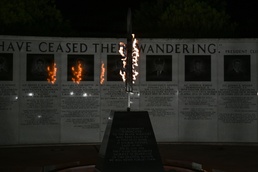
EGLIN AIR FORCE BASE, Fla. – Airmen from the 33rd Maintenance Squadron have worked to revitalize the flaming sword centered on the 33rd Fighter Wing’s Khobar Towers Memorial by modifying it to keep the flame burning without environmental disruption.
The evening of June 25, 1996 went down in history as a tragic night of lasting impact when terrorists bombed Khobar Towers, a housing complex in Dhahran, Saudi Arabia, killing 19 U.S. Airmen – 12 from the 33rd FW. The sacrifice of the Airmen will forever root the 33rd FW’s values and continue to fuel the mission.
In 1997, Airmen from the 33rd FW milled a stainless steel sword to be placed at the center of a memorial located at the wing. The sword bears a flame that burns continuously, representing an everlasting legacy “forged by fire.”
As the 30th anniversary of the bombing approaches, Airmen from the 33rd Maintenance Squadron have been working to revitalize the sword by polishing the steel and making structural modifications to keep the flame burning without environmental disruption. Senior Airman Adam Williams, 33rd MXS metals technology journeyman, and Airman 1st Class Sir Christon Oliver, 33rd MXS metals technology apprentice, have combined expertise and worked diligently to properly modify the sword and refresh the original design.
“The flame kept going out. So we’ve made little fins that go on the side to protect the flames from going out from wind, leaves, debris, anything like that,” Williams explained.
Williams fabricated the fins from sheets of metal, while both Williams and Oliver produced the welds cleanly attaching the fins to the blade. They cut 19 holes representing the 19 lost Airmen into the sides of the sword allowing the flame to disperse.
“There’s some propane that goes through it, so we’ve got holes on each side that, when the sword is connected to the base, it uses regular pressure to ignite, and that’s how it stays lit all the time,” Williams added.
One Airman assigned to this project retains a deeper connection to the sword and the legacy behind it. Williams was born in Jeddah, Saudi Arabia, a month and a half after the Khobar Towers bombing. Williams’ father, a U.S. Navy veteran, was working as a contractor in Saudi Arabia at the time of the attack, and the family lived close to the site of the attack.
“I spent 18 years in Dammam, which is 45 minutes from Khobar Towers. So as I grew up, to go into town, you had to drive by Khobar Towers and that whole area, and that was my childhood,” said Williams, “[The Khobar Towers memorial] resonated with me, because I knew where it was and what the impact was.”
Williams later joined the Air Force and happened to be stationed at the wing linked to this significant part of his youth, and he shared what it means to him.
“I feel so honored to be able to be a part of this history. I literally walked those streets where it happened, and I still sometimes get goosebumps,” said Williams.
The sword represents more than just the centerpiece of the memorial.
“[The sword’s significance] is keeping the heritage alive and honoring those that did die for us. It’s also making sure that those family members that do come, see that we’ve put the effort in and made time for them, because they have the loved ones that made the ultimate sacrifice,” Williams added, “We’ve put the effort in to make sure it’s going to withstand the test of time, and I think in 30 years all it will need is a little touch up.”
With the 33rd MXS’s efforts, the flaming sword will continue to burn, withstanding the environment for years to come.
“The incredible service, sacrifice, and resiliency our Airmen demonstrated during the Khobar Towers tragedy is part of our Nomad legacy. That legacy wasn’t achieved from a single event; it’s an honor we earn and maintain every day with our actions,” said Col. Dave Skalicky, 33rd FW commander, “Our commitment to that legacy is what I see in that sword.”