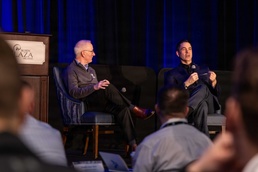
Readiness does not begin when the mission starts. It is built long before through deliberate planning, clear requirements, trusted data, and strong relationships. That message set the tone for the opening day of the Requirement Development Workshop held April 14 to 16 in Orlando, Florida, during a first-of-its-kind Leadership Panel.
The panel brought together Thomas Brown, Deputy Director of Civil Engineers; Jonathan Byrnes, Director of the Air Force Installation and Mission Support Center A2/5/8; and Col. Jason Glynn, commander of the 99th Air Base Wing at Nellis Air Force Base, Nevada, to discuss how Civil Engineers enable readiness across the force.
Brown, who moderated the discussion, framed the session as an opportunity for the field to directly engage with senior leaders and gain perspective on how decisions are made at higher levels.
“This is a great opportunity to get the perspective of senior leaders,” Brown said.
Throughout the session, Byrnes emphasized that while Civil Engineers are highly effective at solving immediate challenges, the enterprise must expand its focus to include long-term planning.
“We’re really good at solving today’s problems,” Byrnes said. “What we haven’t changed is that we haven’t started to think longer range.”
From his perspective at AFIMSC, future readiness depends on shifting from reactive fixes to preventative approaches that align near-term investments with long-term outcomes.
“Instead of just saying these are the things we have to fix now, we must take on that preventative maintenance mindset and think about what we can do in the next three-to-five years that will really make a difference over the next ten,” he said.
Byrnes also highlighted the importance of data in enabling those decisions. Without trusted, authoritative data, installations struggle to advocate for resources and execute at scale.
“We’ve got to have good data. We’ve got to build confidence in that data. And we’ve got to build data-literate Civil Engineers across the enterprise,” he said.
The conversation then turned to requirements development, with Byrnes stressing the need to clearly tie infrastructure needs to operational outcomes. Vague or generic descriptions make it difficult for senior leaders to assess risk and prioritize funding.
“Saying a squadron can’t do its mission doesn’t really tell me anything,” Byrnes said. “I need to know what happens if jets can’t launch, if vehicles can’t be repaired, or if security forces can’t control the installation.”
Glynn offered the installation commander’s perspective, reinforcing how Civil Engineers directly enable mission readiness at the base level. At Nellis Air Force Base, he noted that readiness is the single priority driving all decisions.
“We’ve focused our wing on readiness as a single priority, and we break that down into installation readiness and individual readiness,” Glynn explained.
He emphasized that installation readiness depends on resilient infrastructure, integrated systems, and strong partnerships across the installation. Those partnerships begin with understanding mission needs at a personal level.
“The only way to understand what mission partners need is to build relationships and know people by name,” Glynn said.
Glynn also underscored the value of early career experience in planning and programming, noting how it shapes leaders’ ability to make informed decisions later on.
“That baseline understanding I got in programming has paid me back over and over again throughout my career,” he said.
Both leaders highlighted that effective requirements are the result of deliberate collaboration across multiple functions, including engineering, contracting, communications, and mission partners.
“A good requirement is a well-integrated requirement, across the squadron, across mission partners, and across support functions,” Glynn said.
Strong requirements, backed by trusted data and built through collaboration, are what enable installations to compete for resources and maintain readiness over time.
The Leadership Panel reinforced that readiness begins long before a project is executed. It starts with how Civil Engineers define problems, build relationships, and plan for the future. By focusing on mission impact and disciplined requirements, the Civil Engineer enterprise is positioning installations to meet today’s demands while preparing for tomorrow’s fight.