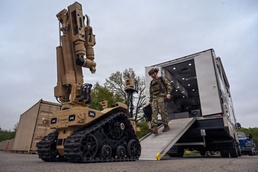
RAMSTEIN AIR BASE, Germany – When a suspicious package is reported, a call goes out across the installation. For most, that call means stop, back away and wait. To the 786th Civil Engineer Squadron explosive ordnance disposal flight it means the opposite.
They move toward the danger.
EOD is one of the most specialized career fields in the U.S. Armed Forces, and one that may not be as understood. Most people only see the badge or hear the title. What they rarely see is the deliberate, methodical thinking that happens before anyone takes a single step toward a threat.
“As soon as you get a call, you put your game face on,” said Staff Sgt. Christian Brown, 786th CES EOD team leader. “I get a flow chart that goes through my head: What is everything we need for this problem, and what is the best way to get it set up to be as efficient as possible?”
Speed without discipline is dangerous. What sets EOD technicians apart isn’t how fast they move. It’s how meticulous they think when everything around them is telling them to panic.
"We can never eliminate the inherent risk that comes with our job," Brown said. "But we're always striving to mitigate it."
That mindset doesn't arrive fully formed. It's built through months of training at Eglin Air Force Base, Florida, and years of experience that continues long after the schoolhouse.
"You come out of school just gung-ho, super confident," Senior Airman Cameron Poe, 786th CES EOD team member said. "You get to your flight and you're just like, ‘oh’. You start from zero and really start learning what this job is."
For Poe, the importance of humility is a pivotal component of staying grounded and clear-sighted. Confidence in EOD isn't arrogance; it's a precision tool built through knowledge, tested through training, and necessary for the job to succeed.
"Coming off as cocky is better than coming off as incompetent," Brown said. "Especially when you and other people's lives are at stake."
That confidence has to carry through the entire team. Brown learned that lesson early in his career, and it’s shaped how he leads today.
"The easiest way to do well on an operation is to just be comfortable," Brown said. "It's up to the team leader to set that flow. Whatever you have to do to set that tone, as an NCO you are in charge of that."
For Brown, that weight of responsibility becomes clearest at graduation. EOD technicians don't receive their badge on a parade field. They receive it at the EOD Memorial Wall, Kauffman EOD Training Complex, Eglin Air Force Base, Florida, where the names of every fallen technician since the career field's inception are etched into the wall.
"You get your diploma, you get your badge in front of this legacy that's left behind," Poe said. "And you have a responsibility to uphold."
That responsibility doesn't wait long to be tested. The threat landscape that EOD technicians now face is shifting faster than ever, and the career field is racing to keep pace.
Drones, once a peripheral concern, have become one of the most pressing challenges the career field faces. The 786th CES EOD trains against simulated versions of those threats, adjusting tactics as new information arrives from conflicts abroad.
"The career field describes the relationship between emerging threats and EOD technicians as a cat and mouse game," Brown said. "Emerging threat, EOD techs find a way to solve it. Another threat, EOD techs find a way to figure it out. It just keeps building."
That adaptability extends far beyond the training range. At Ramstein specifically, the mission reaches across borders and back through decades of history, binding American Airmen to Allies still reckoning with the ordnance of a war that ended eighty years ago.
The 786th CES maintains active partnerships with EOD Allied partners across Europe, working alongside host nation teams on unexploded ordnance that has been buried across the continent since 1945.
"Our bread and butter here is the partnership role that we play," Brown said. "I've gotten to go to the Netherlands, Slovakia, Sweden, Luxembourg and work with these guys, see how they do the same thing that we do.”
For the Airmen of the 786th CES EOD flight, the mission is rarely visible and that's exactly how it's supposed to work. The call is made, and deliberate action follows.
The chaos doesn't stop. They just learn to adapt.