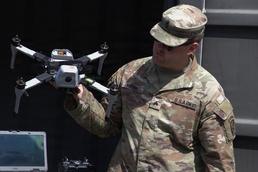
FORT DRUM, N.Y. — Leaders from across the 10th Mountain Division (LI) gathered at Fort Drum June 2–5 to participate in the Counter-Small Unmanned Aircraft Systems (C-sUAS) Academy, a train-the-trainer program, ultimately designed to prepare Soldiers for the rapidly evolving drone threat on the modern battlefield. The academy provides junior leaders with the knowledge and practical experience needed to plan, resource and execute counter-drone training within their own formations. During the course, participants learned both kinetic and non-kinetic methods for detecting, tracking and defeating unmanned aerial systems while also gaining experience planning realistic training events. “This is day three of our Counter-UAS Academy, our kinetic and non-kinetic range day,” said Maj. Tom McGinnis, assigned to the 10th Mountain Division G-3 Future Operations Cell. “First and foremost, it shows leaders how to plan, resource and lead a training event like this themselves. It’s a replicable model they can take back to their formations.” According to McGinnis, the academy is not intended to create expert counter-UAS operators, but rather to equip leaders with the tools necessary to begin developing tactics, techniques and procedures within their units. “There really aren’t any standardized tactics, techniques, or procedures across the Army yet,” said McGinnis. “The quickest way we develop them is by equipping leaders to get out in the field and train.” During the range portion of the academy, Soldiers engaged drones with small arms and observed the effectiveness and limitations of various counter-sUAS capabilities. The training highlighted the challenges posed by modern drone technology and reinforced the importance of adapting to emerging threats. One such Soldier, Sgt. Andrew Hector, an infantryman from 2nd Battalion of the 22nd Infantry Regiment, affectionately nick-named ‘Triple Deuce’, was successful at shooting down one of the practice drones. It only took him a few shots on his first try. “The demonstration was to show how difficult it is to engage a UAV with a firearm,” said Hector. “It was pretty difficult. In the first few seconds, I couldn’t even see the target, and with it moving so fast and constantly changing patterns, it was hard to get shots on target.” The academy reflects a broader Army-wide effort to adapt to lessons learned from current conflicts, in which unmanned aerial systems have become a persistent threat at every echelon.
McGinnis noted that drones can be manufactured cheaply and deployed rapidly, the tactics surrounding them are constantly shifting. That makes this training critical. Leaders are empowered to continuously refine their strategies, ensuring their formations are always prepared to neutralize the threat. For participants, the training provided valuable insight into the realities of the future battlefield. “It’s a huge eye-opener,” Hector said. “You have to change a lot of your tactics, a lot of your strategies, and keep yourself up to date.” As the Army continues to refine its approach to drone warfare, leaders within the 10th Mountain Division are working to ensure Soldiers are prepared for future conflicts before they face those challenges in combat. “What we can affect right now is training,” McGinnis said. “We’re trying to equip leaders to start thinking about this fight so that the time we have to figure it out isn’t on the battlefield when we’re facing a life-or-death threat.”