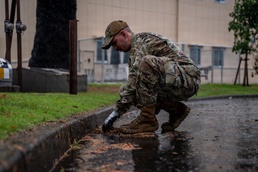
YOKOTA AIR BASE, Japan - While deployed on a temporary duty assignment to conduct annual training requirements, Airmen with the 121st Air Refueling Wing Civil Engineer Squadron were able to assist with activities in response to Typhoon Jangmi at Yokota Air Base, Japan, June 3, 2026.
The arrival of the typhoon presented unique challenges and training opportunities for the Airmen.
“Our role as CE is assessing and responding to damage to buildings, roads, and infrastructure. When the typhoon hit, we did exactly that side-by-side with the Yokota engineers,” said Master Sgt. Brooke Scheidecker, 121st CES Operations Management Productions Controller.
As operations manager, Scheidecker establishes response routes and corresponding damage assessments for the most critical facilities, enabling the CE team to reach and inspect them efficiently.
“For Typhoon Jangmi, we dispatched our heating, ventilation, and air conditioning personnel, as well as our plumbing personnel, to clear clogged drains near roads to prevent flooding,” said Scheidecker. “Our purpose for being here is to practice what we would need to do back home or in a deployed environment, so having this real-world experience helps us to be better prepared for future scenarios.”
According to Major Adam Winebrenner, 121st Air Refueling Wing Deputy Dase Civil Engineer, when Air Force installations are impacted by natural or manmade disasters, the Emergency Operations Center (EOC) serves as the central hub for installation command and control during contingencies, disasters, and wartime operations. CE Emergency Management and Prime Base Engineer Emergency Force (Prime BEEF) teams organize damage repair actions, deploy response forces, and drive the base’s recovery efforts.
Once the damage has been assessed, teams of rapidly deployable CE professionals, called Disaster Recovery Response Teams, are dispatched to assess damages using predefined routes throughout the location to ensure critical roadways and infrastructure remain operational.
“By the 121st CES supporting the Typhoon Jangmi response and EOC operations, our civil engineers can build on their capabilities and experience,” said Winebrenner. “This critical experience ensures they can mitigate weather-related risks to maintain safe and operational installations during severe weather.”
Although Typhoon Jangmi was not part of the scheduled annual training, the experience strengthened CE’s ability to adapt to unforeseen conditions.
“The CE Squadron is essential to the base remaining operational when real-world disasters happen,” said Scheidecker. “Without engineers and the skills we bring, the base would not be able to operate. Having the opportunity to respond with, and learn from, the 374th CES was invaluable for our team.”