FORT SILL, Okla. — Soldiers who need to qualify on machine guns at Fort Sill will soon have a centralized, upgraded range built by Soldiers who know exactly why that training matters.
By applying critical thinking and looking beyond the standard path, leaders and engineers at Fort Sill are demonstrating how “getting to yes” can save time and taxpayer dollars while significantly improving the quality of training facilities.
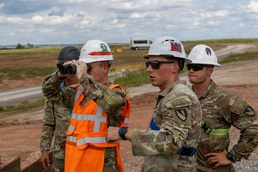
The 104th Engineer Construction Company, 62nd Engineer Battalion, 36th Engineer Brigade, is converting Fire and Movement Range 2 into a Multi-Purpose Machine Gun Range to support machine gun qualification for Fort Sill units and external training units. The project is designed to restore a critical training capability, increase throughput and provide Soldiers with a more efficient place to train on machine gun systems.
Col. John Morgan, U.S. Army Garrison Fort Sill commander, toured the construction site May 20 with Glenn Waters, acting deputy to the garrison commander, and Michael Spears, acting director of the Directorate of Plans, Training, Mobilization and Security.
Brig. Gen. Patrick Costello, Fires Center of Excellence and Fort Sill commanding general, visited the range May 28 to observe the work firsthand and speak with 104th ECC Soldiers about their role in building the new training capability.
Solving a training gap
The need for the range grew after the Joint Counter-small Unmanned Aircraft System University was stationed at Fort Sill in 2022 and occupied the installation’s primary Kerr Hill Machine Gun Range. That pushed units onto three geographically separated, nonstandard temporary ranges, which reduced training efficiency and created a qualification bottleneck for units that need to train machine gun crews.
Fire and Movement Range 2 was identified as the solution: an underused range that could be converted into a centralized facility for machine gun qualification.
Waters said the project directly supports readiness.
“This range is all about readiness,” Waters said. “We need modern, top-tier facilities to train our Soldiers, and this MPMG range gives them exactly what they need to master their weapons systems and build lethality right here at Fort Sill.”
When complete, the range will support the M249 squad automatic weapon, M240B machine gun, M2A1 .50-caliber machine gun and MK19 grenade machine gun. Soldiers will be able to train on those systems mounted on vehicles, fired through common remotely operated weapon stations, or used dismounted from tripods and bipods.
The range footprint includes six firing points, 75 infantry and armor target points from 100 to 1,300 meters, two maintenance access roads totaling about 2,600 meters, drainage improvements and supporting range infrastructure.
Faster and less expensive
A traditional military construction project had been projected for fiscal year 2036 at about $25 million. Through troop construction, Army engineers building a real-world project as part of their training, Fort Sill and the 104th ECC are delivering the capability about 10 years early for roughly $500,000.
Morgan said seeing the project early in his command showed what can happen when leaders think beyond traditional timelines and focus on what Soldiers need now.
“We can’t wait 10 years down the road to have a better range,” Morgan said. “We need a better range for the Soldiers today.”
Morgan said the project also shows how Fort Sill can solve problems across the garrison: identify the stakeholders, bring the right people together and find a practical answer that supports Soldiers.
“It’s proof of concept that we can build things faster and cheaper on behalf of our Soldiers,” Morgan said.
Waters said the project is an example of what happens when the installation focuses on solutions instead of barriers.
“It’s a perfect example of what happens when everyone leans in together,” Waters said. “We identified a critical training requirement, and by partnering with the garrison and utilizing the in-house talent of the 104th Engineers, we’re saving time and maximizing our resources. It proves that when the installation and the engineers work hand-in-hand, we deliver a better, faster product for the force.”
Soldiers building for Soldiers
For the 104th ECC, the project is more than construction. It is mission-essential training with a lasting purpose.
Capt. Jacob Sroka, commander of the 104th ECC, said his Soldiers are building a range that will outlast their time at Fort Sill and serve future units for decades.
“Our Soldiers understand this range will stand for the next 50 years units, and Soldiers will qualify and build their lethality on this range for generations to come,” Sroka said.
The work requires horizontal construction engineers, vertical construction engineers, surveyors, equipment maintainers and support Soldiers to work together. Soldiers are building firing points, placing target infrastructure, shaping access roads, improving drainage and ensuring the range is built to standard. Waters said the Soldier-to-Soldier impact is one of the most powerful parts of the project.
“Seeing Soldiers building infrastructure for other Soldiers is a powerful thing to witness, they know exactly how important this range is, and they are getting after it,” Waters said.
More than moving dirt
Warrant Officer 1 Ignacio N. Re, construction engineering technician for the 104th ECC, said the work requires more than moving material across a range.
Firing points must be placed precisely. Drainage must prevent erosion and flooding. Access roads must allow range personnel to service target systems. Surveyors and equipment operators must get the grade right the first time.
“Turning an existing range into a functional training asset requires far more than equipment operators moving material,” Re said. “It takes coordinated engineering expertise in surveying, design interpretation, drainage, earthwork, quality assurance and construction management.”
Re said proper grade, drainage and soil stability determine whether the range will hold up under years of training use.
“Proper elevations, drainage flow and soil stability are foundational to every structure and roadway built afterward,” Re said.
Fort Sill’s terrain and weather have given the engineers real-world challenges. Soldiers have had to adjust drainage plans, stabilize low areas and account for Oklahoma clay soil that holds water and affects construction. Re said those challenges are part of what makes the project valuable training because Soldiers must adapt, communicate and solve problems as conditions change.
Garrison support behind the scenes
The project also highlights the garrison support behind the scenes. DPTMS, Range Operations, Directorate of Public Works partners and other Fort Sill agencies helped move the project from concept to construction through site surveys, environmental and cultural reviews, unexploded ordnance assessments, design coordination, material procurement and daily support to the engineer company.
Sroka said that support allowed the 104th ECC to focus on the mission.
“Working with the various Fort Sill agencies supporting our project up here has been an incredible experience,” Sroka said. “They’ve accommodated us with every requirement and enabled us to focus on the project.”
Spears said the effort matched a Fort Sill capability gap with an engineer unit’s training requirement. Fort Sill needed a better machine gun range, and the 104th ECC needed realistic construction training tied to its mission-essential tasks.
During Costello’s May 28 visit, Soldiers and leaders explained the construction process, the scale of the project and how the completed range will improve machine gun qualifications at Fort Sill. At the end of the tour, Costello presented commanding general coins to Staff Sgt. Carola Chavez, Spc. Evan Floyd, Spc. Sato Mongkeya, Spc. Guillermo Jimenez, and Spc. Joshua Farias for their contributions to the project. Costello also told the Soldiers their work is important to Fort Sill’s mission.
For Morgan, the project also reflects the work done every day by Soldiers and civilians whose efforts may not always be visible but directly support the Army mission.
“What they do is important, and what they do is absolutely value added to the team,” Morgan said. “They should be proud of planting the seeds of the trees they might not see grow.”
When complete, the Multi-Purpose Machine Gun Range will give Fort Sill a centralized training capability that improves scheduling, increases throughput and supports units preparing for real-world missions. For the Soldiers building the range, the project is more than a construction mission. It is a chance to leave behind a capability that will help future crews qualify, train and prepare to deploy.
Waters said the work being done now will have a lasting impact.
“The hard work they are putting in today is going to pay dividends for every Soldier who trains on that range for years to come,” Waters said. “I couldn’t be prouder of what they are accomplishing.”