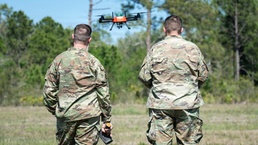
Far from their home stations, Airmen assigned to the 184th Wing’s Point Defense Battle Lab (PDBL) traveled from Kansas to Avon Park Air Force Test Range, Florida, to conduct small Unmanned Aircraft Systems (sUAS) operations with their counterparts from North Dakota’s 319th Reconnaissance Wing, March 22 to April 2, 2026.
The joint rehearsal, known as the Valuable Asset Protection Operations Rehearsal, or VAPOR 26.1, focused on evaluating passive defense measures designed to protect vital Air Force assets from sUAS.
Rather than kinetic engagements like shooting down aircraft, VAPOR strictly evaluated non-destructive methods.
The training kicked off with more than 300 sorties, placing cutting-edge camouflage, concealment, and deception plus hardening techniques into highly realistic operational scenarios. The goal was to identify the most effective techniques to make critical assets harder for drones to find and target in the first place.
“Small UAS are relatively inexpensive, widely available, difficult to attribute, and increasingly capable of conducting both intelligence, surveillance, and reconnaissance, and one-way attack operations,” explained 2nd Lt. Blake Elliott, Red Air Director, PDBL-KS. “Passive defense measures like camouflage, concealment, deception, and hardening force our adversaries to spend more time searching, increase uncertainty in their targeting process, and reduce their confidence in what they are seeing.”
Once airborne, PDBL-KS led the Red Air operations. They utilized Group 1-3 sUAS to replicate the capabilities of hobbyist, informed, and state-level actors.
On the ground, commercial-off-the-shelf non-kinetic technologies were put to the ultimate test. Their ability to obstruct visual, infrared, and thermal reconnaissance was heavily scrutinized against the Red Air threat.
“If an adversary cannot confidently detect, identify, or validate a target, you disrupt the entire kill chain before it ever reaches the engagement phase. That buys commanders time, preserves combat capability, and complicates enemy decision-making,” Elliott further explained.
The collaboration at Avon Park stems from Air Combat Command’s (ACC) recent establishment of the Point Defense Battle Lab, a critical initiative designed to safeguard installations and ensure the continuity of air operations.
“The success of VAPOR came from combining different skill sets and operational perspectives into one integrated team,” Elliott said. “Airmen from the 319th Reconnaissance Wing brought extensive experience in operations rehearsal planning, while the 184th Wing Airmen contributed strong expertise in sUAS employment, threat replication, and realistic adversary tactics.”
Elliott noted that having skilled operators accurately replicate real-world ISR and attack profiles created a highly realistic operating environment.
It also demonstrated how Total Force partnerships between active-duty and Air National Guard personnel can rapidly accelerate innovation to solve emerging challenges.
While the broader PDBL mandate includes developing tactics to detect, track, and neutralize airborne threats, VAPOR 26.1 focused strictly on the lab's operational experiment and red-teaming initiatives.
By testing a wide range of commercially available technologies in a realistic environment, the Air Force ensures the solutions it pursues are both practical and effective during real-world operations.
“Events like VAPOR 26.1 allow the Air Force to evaluate solutions to emerging threats under realistic conditions before those threats are encountered in a contested environment,” Elliott stated. “They also help develop a culture of survivability across the force by training Airmen to think about signature management, deception, dispersion, and asset protection as everyday operational requirements rather than contingency actions.”
Ultimately, VAPOR 26.1 reinforced a reality the military can no longer ignore: in the modern threat environment, survivability starts well before the first shot is fired.
“If we can deny detection, create uncertainty, and complicate targeting, we force the adversary to slow down, second-guess their decisions, and waste resources,” Elliott concluded. “Exercises like VAPOR ensure we are not waiting to adapt after a conflict starts — we are building that resiliency now.”
Integrating their shared expertise, the Kansas and North Dakota PDBLs utilized VAPOR to deliver critical tactical-level data to ACC, providing strategic leaderswith specific solutions to protect assets against the dynamic sUAS threat.