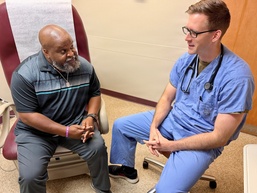
FORT POLK, La. — Alfred Coleman knew something wasn’t right.
There was no pain. No injury. No obvious reason for concern. One testicle had simply become larger than the other.
Instead of ignoring it, the Bayne-Jones Army Community Hospital employee made an appointment that may have saved his life.
That decision led to the early detection and successful treatment of Stage 1 testicular cancer, a highly treatable disease that often presents with subtle symptoms.
Coleman, a retired Army sergeant first class and security assistant at BJACH, said he first noticed the change in late December 2025 or early January 2026. At the time, he had no pain or discomfort.
Because he stays current on his annual health screenings and maintains a relationship with his primary care provider, Coleman said he knew he needed to act.
“I’m up on my health,” he said. “I do my annual checkups through the VA and at BJACH. I had a discussion with my wife, and I told her, ‘I think I need to go get this checked.’”
Coleman saw Capt. Addison Bray, a primary care physician at BJACH, Jan. 29. During the appointment, Coleman explained what he had noticed. Bray performed an exam and immediately ordered imaging.
Within about 30 minutes of the ultrasound, Coleman said Bray called him back to his office.
“I knew right there,” Coleman said. “He called me into the office to tell me it was testicular cancer, and naturally I got emotional. I broke down.”
Bray said the most common sign of testicular cancer is often a painless lump or mass, which can make the condition easy to dismiss.
“This can be counterintuitive because you get worried if something hurts or doesn’t feel right,” Bray said. “A common mentality would be, if it doesn’t hurt, then why bother? But this is all the more reason to get it checked out.”
After the diagnosis, Coleman said the BJACH team moved quickly. He received a CT scan to determine whether the cancer had spread. The scan came back negative. The cancer had not spread to his lymph nodes or other parts of his body.
Within hours, BJACH staff helped coordinate follow-on care with a urologist in Shreveport. Coleman said he was seen within days and underwent surgery Feb. 12 to remove the affected testicle.
“I was Stage 1,” Coleman said. “Thankful that it was Stage 1.”
Coleman was diagnosed with seminoma, a type of testicular cancer that is highly treatable, especially when detected early. He did not require chemotherapy or radiation. He returned to work March 1 and now receives regular follow-up care, including blood work and CT scans every three months for the next two years.
Bray said Coleman’s case is an example of what can happen when patients seek care early and the care team responds quickly.
“This was 100% on my support staff,” Bray said. “They did a fantastic job getting everything set up. A few phone calls later, and Mr. Coleman got seen in about four to five days, which is incredible.”
While testicular cancer is rare, it is most common in younger men, particularly those between ages 15 and 35, according to Bray. Coleman, 54, said his diagnosis was unexpected because he did not fit the typical demographic profile.
Still, he wants other men to understand that cancer does not always follow a predictable pattern.
For Coleman, the emotional weight of the diagnosis was real. But once he processed the news, he said his mindset shifted quickly toward treatment, recovery and survival.
“Once I got over the emotional side of it, I focused immediately on treatment, recovery and getting better,” he said. “What do I have to do?”
Coleman said several factors influenced his decision to seek care quickly, including access to healthcare, encouragement from his wife and a strong support network of friends who openly discuss health concerns and hold one another accountable.
“It’s a combination of everything,” Coleman said. “Having access to care, having that support group, having my spouse.”
Coleman said conversations about health are normal among his close circle of friends. The group regularly checks on one another, discusses medical concerns and shares lessons learned from doctor visits.
“Talk about it amongst your friends,” Coleman said. “We share information. We make sure we exercise. We go to the doctors. If one doctor tells one of us something, we share that information.”
His support system helped him through treatment and recovery. His wife encouraged him to seek care. His friends checked in on him. His BJACH teammates and chain of command supported him throughout the process.
“I have grandkids, and I’m trying to be around for them,” Coleman said.
Coleman also found comfort in his mother’s response when he shared the diagnosis.
“When I told her, she said, ‘I’m not worried about you. You’re going to be OK,’” Coleman said. “She told me, ‘I’m going to pray on it. You’re covered.’”
That confidence helped steady him during an uncertain time.
“I’m an only child,” Coleman said. “I was kind of taken aback. But that was her mentality. ‘You’re good. You’re going to be OK.’”
Growing older, losing friends at young ages and becoming a grandfather have all shaped the way Coleman approaches his health.
“I know a lot of guys I grew up with who didn’t see 40, didn’t see 30, because of various health reasons,” he said. “Some of them didn’t have that access to care. I have access to healthcare. I earned it. I’m going to use it.”
During Men’s Health Month, Coleman said his message to other men — especially Soldiers, retirees, fathers, husbands and grandfathers — is simple: stop waiting.
Bray echoed that message and said seeking care supports readiness, not weakness.
“A ready and fit force is the most effective,” Bray said. “You can only tough it out for so long until something breaks.”
Bray said routine screening for testicular cancer is not recommended for everyone because the disease is rare and different types of testicular cancer require different diagnostic approaches. However, patients with specific risk factors, such as a previous history of testicular cancer or a family history of the disease, should talk with their provider.
For any man who notices a lump, swelling, pain, heaviness or any unusual change, Bray’s advice is direct.
“Make an appointment and get it checked out,” he said.
Coleman said he hopes sharing his story encourages other men to pay attention to the changes their bodies are trying to tell them before it is too late.
What began as a small change became a lifesaving decision.
Today, Coleman is cancer-free, back at work and focused on what matters most — being there for his wife, his family and the grandchildren who are counting on him.
“Get out of that stigma of being this macho man,” Coleman said. “Listen to your body because you know when something’s not right.”