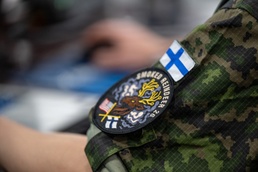
JOINT BASE LANGLEY-EUSTIS, Va. — Cyber threats are borderless, accelerating and capable of crippling entire nations in seconds. Defending in this volatile digital landscape requires moving away from isolated operations and establishing ironclad international alliances before the next major attack—highlighting the strategic importance of international cyber cooperation in enhancing national security. This reality brought American and Finnish forces together on a shared cyber operations floor at Joint Base Langley-Eustis in Hampton, Virginia.
While Exercise Smoked Reindeer 2026, held April 13-24, has concluded, the strategic framework established at Langley will continue to influence coalition cyber operations. The bilateral exercise between the Finnish Air Force and the 185th Cyberspace Operations Squadron, 192nd Wing, Virginia Air National Guard, marked a historic milestone for the Virginia National Guard’s State Partnership Program.
Moving beyond introductory exchanges, the exercise established a rigorous, standardized team certification process that aligns with the National Guard Bureau’s priorities: Securing the Joint Force Warfighter, Safeguarding the Homeland, Deepening International Partnerships, and Serving as a Critical Force Multiplier for the National Defense Strategy.
Through the SPP, the VNG and FINAF have transformed diplomatic ties into concrete operational advantages.
"Partnerships are imperative to maintaining international stability," said U.S. Air Force Lt. Col. Elizabeth Maksim, 185th COS commander. "Working alongside the Finnish Air Force helps build trust on both sides, and trust underpins everything we do as a military. Each exercise we execute together helps strengthen our interoperability and deepens the relationship between our partner nations."
The two-week exercise pushed both units past theoretical planning and into live, side-by-side operations to hunt for and neutralize simulated network threats. This integration leveraged a distinct guard advantage. It leveraged the civilian cybersecurity expertise of dual-status citizen Airmen to accelerate innovation on the digital battlefront.
“Smoked Reindeer is a certification event conducted to USCYBERCOM standards to evaluate the Finnish Air Force’s ability to execute its mission essential tasks, aligned with [U.S. Air Force] Cyber Protection Team training and readiness standards,” Maksim said. “So, it’s a way to ensure the Finnish Air Force can handle cyber threats using the same standards and playbooks we use.”
The mission lead emphasized that standardizing operations across international lines is key to modern, integrated defense.
“Operating to common standards helps ensure we’re collectively prepared to respond to cyber threats," Maksim said. "Additionally, working alongside a partner nation is invaluable experience because those interpersonal connections are part of what makes us successful as allied nations. Our Finnish counterparts showed us what it looks like to integrate intelligence more heavily into every stage of cyber defense, and it pushed us to think differently about how we fuse intel with operations.”
The exercise supported FINAF’s recent restructuring from a reactive posture to a threat-driven, proactive hunting methodology emulating the USAF CPT model. To ensure long-term sustainability, the 185th COS utilized a “train-the-trainer” approach, creating an initial cadre of Finnish evaluators capable of conducting future certification events in Finland that mirror U.S. criteria, directly enhancing NATO interoperability.
“Working face-to-face is very important because it builds the trust needed in the cyber domain,” said FINAF Maj. Marcus Lönnqvist, project officer for the evaluation at Air Force Command Finland. “You can get the work done via emails and online meetings, but relationships are built during the coffee breaks. It is so much easier to work together when you actually know your colleague as a person, not just a name in the email signature or online meeting."
The specialist noted that building these human connections changes the dynamic of global cyber response when an active threat emerges.
"Training with allies makes us stronger together," Lönnqvist added. "When you work with someone who has a different perspective, it helps you to evaluate your actions and to see your decisions from another point of view. This is important because real-world cyber threats are global and can affect both of our nations. This close cooperation makes it easier for us to work seamlessly together in both peacetime and crises.”
For the Finnish personnel, the hands-on experience brought prior desk planning into sharp focus.
“For us, the highlight was gaining new insights into how the U.S. team works,” Lönnqvist said. “We had documentation in place, and we trained and planned with Virginia Air National Guard personnel before Smoked Reindeer 26. But it took us a couple of days to really understand how the leadership and mission elements operate under U.S. standards. When everybody knows the documents and processes, it is easier and quicker to set up a joint team. Common standards also help determine which skill sets are needed from team members. Working together and sharing ideas with allies, as we did during Smoked Reindeer 26, is a force multiplier in the long run.”
By modeling the future of coalition cyber protection, the VaANG and FINAF validated that the SPP is not just about building relationships—it’s about deploying a lethal, unified combat reserve that is “always ready, always there” to defend the homeland and prevail in the global warfight across every domain, including the digital battlefront.