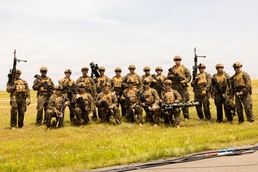
MCAS IWAKUNI, Japan – Thousands of spectators lined the flight line, their eyes fixed on the sky as the distinct hum of tiltrotor engines grew louder. Within moments, an MV-22B Osprey touched down, kicking up dust as a team of U.S. Marines swarmed out of the back while executing a simulated air assault.
For the crowd watching at Marine Corps Air Station Iwakuni on May 2 to 3, 2026, Friendship Day was a display of military precision, but for the Marines executing the mission, it was a powerful demonstration of readiness, integration, and the strength of the U.S.-Japan alliance.
The company of Marines conducting the simulated raid belong to 1st Battalion, 25th Marines, a reserve company currently deployed to 4th Marine Regiment, 3rd Marine Division, as part of the Unit Deployment Program. While their primary mission as part of the UDP is to maintain a forward-deployed, credible combat force in the Indo-Pacific, Friendship Day offered the unique opportunity to showcase their abilities to the Japanese public.
"Our job on UDP as a rifle company is to be ready and show that we’re a credible force in the region for the Marine Corps," said Capt. Patrick Lawler, a Massachusetts native and the platoon commander. "The MAGTF [Marine Air-Ground Task Force] demonstration reinforced that we’re capable of executing at that level. It wasn’t just a display, it showed that we can integrate, coordinate, and perform alongside other elements of the force when it matters."
What the thousands of visitors might not have realized is that the Marines executing the tactical insertion bring an immense array of civilian expertise to their military roles. As a reserve unit, their company is comprised of Marines balancing civilian careers with their military service.
"As a reserve unit, we bring a lot of different real-life experiences into the mix," said Staff Sgt. Kenneth Fox, a platoon sergeant from New York. "Within the platoon, we have guys who work in fields of law enforcement, trades, teachers, farmers, and more. With the widespread real-life experience, it makes it so many of the Marines are able to adapt and learn quickly as well as apply their experiences to the Marine Corps."
Lawler noted that this diverse professional background directly translates to success in high-visibility, fast-paced environments like a live air show.
"Many have full-time jobs back home... so they’re used to operating under pressure," Lawler said. "That shows when things get busy or a little chaotic. They don’t get rattled easily. During Friendship Day, that adaptability stood out. They handled it well and made it look smooth."
"I think it’s important for people to see how everything works together, not just the aircraft by itself," Lawler said. "Watching how it inserts Marines and how everything is coordinated shows what we’re capable of as a Marine Corps when we integrate across the force."
Fox agreed, adding that the demonstration, "shows the public that the Marine Corps can function at a small level and shows the capabilities of a small unit."
Performing a simulated raid in front of a massive live audience presents a different challenge when compared to the isolated training grounds the Marines are accustomed to, adding an extra layer of pressure. However, the unit used the spotlight to sharpen their edge and further increase their readiness.
"There really was not much of a difference," Fox said. "If anything, it helped build the proficiency even more due to more pressure of not wanting to mess up in front of thousands of people."
Beyond the tactical display, the event provided a rare opportunity for direct community engagement within the Yamaguchi prefecture. For many of the Japanese citizens in attendance, Friendship Day represents a unique opportunity to interact with the U.S. military. Leaders emphasized the weight of that responsibility, ensuring their Marines acted as premier ambassadors of the Marine Corps.
"Myself and Capt. Lawler kept it simple. Be professional and respectful," Fox said. "We were there to represent the Marine Corps and we did our best to ensure that everyone we interacted with saw the best side of us."
"The small things matter—how you carry yourself, how you speak to people, and your willingness to engage," Lawler added. "At the same time, I wanted them to be themselves within that standard... They took it seriously but also genuinely enjoyed the experience."
As the smoke cleared from the flight line and the aircraft departed, the lasting impact of the event was found in the mutual respect fostered between the service members and the local community.
"Events like this give people a real chance to connect and understand why the relationship matters," Lawler said, reflecting on the day. "Walking away from the event, I had a strong sense of confidence, not just in our own Marines, but in the strength and professionalism of both the U.S. and Japanese militaries working together."