Jose Medina Medina applies his computer science education and experience to helping Sailors defend themselves.
As a computer engineer at Naval Surface Warfare Center, Port Hueneme Division (NSWC PHD) in California, Medina installs software and troubleshoots technical issues for the MK 160 computer system that controls the 5-inch Gun Weapon System on Navy warships.
“We’re making sure that system is always operational to protect Sailors from attacks,” Medina said.
Medina occasionally reflects on the importance of computer science to the Navy and the world — as well as its impact on his own life.
Challenging and rewarding
Keeping the MK 160 computer system up-to-date with the latest advances requires Medina to continually expand his knowledge of computer science and technology, which he said is his favorite part of the job.
“The fact that I get to learn something new every day is very rewarding,” Medina said.
His role on an Alteration Installation Team also keeps him moving — last year, he traveled 120 days to Navy bases and shipyards around the world.
Every software installation aboard a ship brings new challenges, Medina said, which keeps the work interesting.
“It’s exciting to get to solve different problems every day,” he said.
Chris Quinata, Medina’s team lead at NSWC PHD, emphasized the importance of problem-solving in their work.
“A lot of times the software is not plug and play — there’s a lot of troubleshooting involved,” Quinata said.
That makes Medina’s education in computer science invaluable to his team and to the fleet, according to Quinata.
“His knowledge makes it so much easier to install the weapon system software in a timely manner to get ships ready for operational tasking,” Quinata said.
As a former sailor who doesn’t have a technical background, Quinata said he sees firsthand how ship personnel benefit from Medina’s expertise and his ability to explain technical matters.
“Jose is able to break it down in layman’s terms to provide better understanding to the fleet, so they can utilize their systems to the best capability,” Quinata said. “To be honest, I’ve learned a great deal from him on how to install this software.”
Medina’s own path to learning computer science stemmed from a student outreach program when he was in high school.
STEM connections
As a student at Santa Paula High School in California, Medina participated in the Mathematics, Engineering, Science Achievement (MESA) program through the University of California, Santa Barbara’s College of Engineering. The program offered activities such as competing in a robotics event, attending a summer engineering camp and visiting college campuses.
The experience in MESA opened Medina’s eyes to the potential of a career in the realm of science, technology, engineering and math (STEM), he said. Oralia Razo, then with the MESA program and later a counselor with Santa Paula Unified School District, promoted STEM career paths and helped him apply for college.
After high school, Medina initially attended Ventura College and then transferred to San Francisco State University, where he majored in computer science. When he graduated, he became the second member of his family to earn a college degree, after his sister.
Razo later connected Medina with Ramon Flores, STEM coordinator at NSWC PHD. With guidance from Flores and the help of Robert Casas, a former Santa Paula classmate who was already working at NSWC PHD, Medina landed a computer engineering job with the command in 2023. Medina and Casas, also a computer engineer and software installer, are now colleagues in naval fires installation at NSWC PHD.
“I’m very grateful for all the people who have been there for me,” Medina said. “Dr. Flores has been a big part of who I am at the command.”
About two-and-a-half years into his career at NSWC PHD, Medina is now helping to train new junior professionals (JPs) who join the team.
“That to me is very fulfilling,” Medina said.
As an example, Quinata sent Medina with one of the team’s newest JPs to Pascagoula, Mississippi, to install MK 160 modification software on a ship.
“That says a lot about his character,” Quinata said.
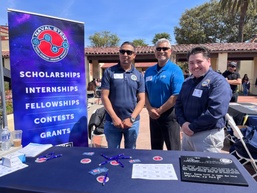
Medina also contributes to Flores’ student outreach activities to promote the command’s STEM career pipeline — at least when he’s not traveling for his own work in the field.
“I try to do as much as I can when I’m in Port Hueneme … to give back a little to the community,” Medina said.