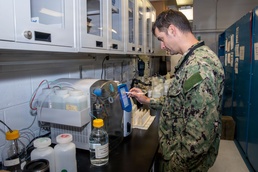
Tucked behind the scenes at Naval Station Norfolk, there’s a team whose work rarely grabs the headlines but is absolutely mission-critical. The civilians and Sailors of the Nuclear Regional Maintenance Department (NRMD)-Norfolk play a key role in keeping the Navy’s nuclear-powered ships and submarines ready for sea, often on short notice and always to the highest standard.
NRMD Norfolk is located at Naval Station Norfolk as a satellite work group of Norfolk Naval Shipyard (NNSY). Unlike the submarines and aircraft carriers undergoing more extensive maintenance at NNSY, the carriers and submarines that NRMD services are still active in the Fleet and have to be ready to deploy when needed.
“We provide what’s called intermediate-level maintenance,” said Dustin Gardner, director of NRMD-Norfolk (Code 300N). “That means we tackle repairs and testing that are too complex for the ship’s crew to handle themselves, but don’t require the scale of a full shipyard overhaul. Our team covers everything from preventative maintenance and troubleshooting to critical system repairs and radiological oversight. If a nuclear-powered vessel needs help while in port, we’re the first call.”
A key to NRMD’s effectiveness is its unique workforce – Sailors form a much higher percentage of the team at NRMD than at the rest of NNSY.
“Having this remarkable blend of civilian and military personnel merges the operational know-how of active-duty Sailors—many who have just come from sea duty themselves—with the deep technical expertise of seasoned civilian shipyard workers,” Gardner explained. “This makes us better across the board, especially when something urgent pops up. Sailors can anticipate fleet needs and communicate them, while civilians ensure repairs are performed to the shipyard’s highest technical standards.”
Machinist Mate Nuclear First Class Alexander Jones serves as a Nuclear Repair Coordinator (NRC), a role that sits at the heart of NRMD’s daily operations in determining requirements and allocating resources. “Our days start early with leadership huddles, syncing on each vessel’s status and needs. Each NRC manages four or five vessels at a time, acting as the bridge between ship and shore,” Jones said. “We translate between the ship’s crew and the shipyard staff, making sure every nuclear-related job is scheduled, resourced, and executed.”
Jones also pointed out the benefits of having civilians and Sailors working side-by-side. “Everyone’s dedicated to getting the ships back to sea,” said Jones. “The Sailors bring their operational background and troubleshooting skills; the civilians bring years of technical mastery. Together, we’re able to jump on short-notice jobs and keep everything running smoothly.”
That blend of expertise was recently on display during primary relief valve testing aboard USS Oregon (SSN 793). “This is one of the most critical maintenance items a nuclear-powered vessel faces,” said Brandon Harris, Nuclear Test Supervisor for NNSY’s Pipefitter Shop (Shop 56). “It’s a job that involves multiple trades, tight timelines, and zero room for error. Thanks to lessons learned from previous jobs and the team’s willingness to innovate, we completed the work with what we call ‘first-time quality’—meaning it was done right the first time.”
For Jones and other Sailors, working alongside civilian experts has been invaluable. “I’ve learned to slow down and plan thoroughly—unless there’s an urgent casualty, deliberate actions lead to better, safer results,” Jones said. “It’s a lesson I’ll take back to the fleet.”
Gardner, who has led NRMD-Norfolk since August 2025, is proud to see his team’s agility and commitment to innovation. “They embrace new approaches and challenge the status quo—always with the mission in mind,” he said. “This is a team that excels, no matter the challenge or the timeline.”