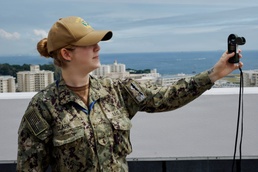
As another typhoon season approaches, a specialized team of Navy forecasters is already locked in a high-stakes battle against the Pacific’s most unpredictable storms.
At the forefront of this effort is the Naval Oceanography Anti-Submarine Warfare Center (NOAC) Yokosuka, which stands ready to provide the critical weather intelligence required during the Tropical Cyclone Conditions of Readiness (TCCOR) season. Operating around the clock, the command fulfills a dual mission: keeping Navy ships safe at sea and protecting military communities ashore.
NOAC provides weather forecasting for installations throughout the Indo-Pacific. “Because the 7th Fleet region is so vast, NOAC’s watch floor monitors the oceans 24 hours a day, 365 days a year,” said Ensign Ethan J. Tomczyk, unit public affairs representative for NOAC Yokosuka. “On average, a typhoon forms somewhere in the region every three weeks. When a storm sets its sights on Japan, NOAC kicks into high gear to protect the base.”
During the Northern Hemisphere typhoon season, an average of 14 individual typhoons occur which directly impact U.S. military installations in the Indo-Pacific. “Our watch team is supplemented with an additional team of forecasters whenever a typhoon is forecast to impact Japan,” Tomczyk said. “Their task is to monitor the storm’s development and compile important information for base and regional commanders to make decisions regarding implementation of safety measures.”
Tracking a large storm is a complex process. Forecasters use satellite data to study ocean temperatures and atmospheric conditions, feeding that information into advanced computer programs. By comparing multiple computer models, they can confidently predict a storm's most likely path.
This vital work is a collaborative endeavor, drawing on a network of regional and national partners. “Whenever a storm system develops which has the potential to evolve into a typhoon, NOAC and Joint Typhoon Warning Center (JTWC) in Hawaii work together to develop forecasts and pass crucial information to decision makers,” said Petty Officer 2nd Class Wilson, an aerographer’s mate at NOAC Yokosuka.
When a storm officially tracks toward Japan, these weather experts meet every six hours to update the forecast. For the Yokosuka community, NOAC’s most important job is figuring out exactly when dangerous weather will arrive and when it will leave.
“The key piece of information for the public is the onset and offset of destructive winds,” Wilson said. “These are defined as winds at speeds greater than 50 knots, which are preceded by damaging winds of 34-49 knots. Because TCCOR indicate how much time remains until a typhoon impacts a location, we analyze the time damaging and destructive winds will reach that location and make TCCOR recommendations accordingly.”
These TCCOR levels are the direct signals base residents use to prepare. They range from TCCOR V (destructive winds possible within 96 hours) down to TCCOR I (destructive winds expected within 12 hours or actively occurring). Whenever the base moves to a new TCCOR level, it is a direct result of the continuous tracking and data provided by NOAC.
While NOAC works tirelessly behind the scenes to track the storm, they emphasize that true readiness starts at home. “The utility of a welldeveloped and understood family emergency plan cannot be understated,” Tomczyk said. “Preparing now with sufficient emergency supplies will eliminate the need to leave a safe location as a typhoon approaches Yokosuka, or any installation in 7th Fleet.”
NOAC weather experts serve as Yokosuka’s first line of defense, transforming storm predictions into the life-saving alerts that protect the entire community. By pairing NOAC’s round-the-clock vigilance with proactive household preparation, the CFAY community remains ready to safely weather whatever this typhoon season may bring.