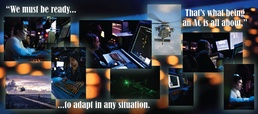
Above the waterline, Wasp-class amphibious assault ship USS Iwo Jima (LHD 7) hums loudly as it cruises through waves of salt spray while Sailors shout over the bone-shaking screams of aircraft taking off from the flight deck. One level below the noise—just through an airtight hatch into the blue-lit space of the Amphibious Air Traffic Control Center (AATCC) and Tactical Air Control Center (TACC), the world grows quiet and the air sits still. Here, the mission is not measured in decibels, but on screens with glowing green vectors.
For the pilots, assigned to the Iwo Jima Amphibious Ready Group (IWO ARG) - 22nd Marine Expeditionary Unit (MEU) (Special Operations Capable), air-traffic controllers and operations specialists are the dependable faces masked by the blue lights in AATCC and TACC. Heard but not seen, they are the calm voices that echo over headsets and speakers—the invisible conductors of a daily multimillion-dollar aerial masterpiece that comes together to ensure smooth flight operations.
“We always have to think ahead and formulate a plan. I love talking to [the] planes. Sometimes it feels like a symphony,” said Air-Traffic Controller 1st Class Britton Johnson, V-6 division leading petty officer aboard Iwo Jima.
The Air-Traffic Controllers of AATCC manage the flow of air traffic within ten nautical miles of the vessels, which comprise the IWO ARG. Once the aircraft fly beyond that radius, there is a coordinated handoff from AATCC to the watch standers in TACC. Under TACC’s control, aircraft pilots receive critical mission-specific data to ensure success of operations.
“Air-Traffic Controllers [in AATCC] handle the safe, orderly, expeditious flow of air traffic throughout ten [nautical] miles and in,” said Air-Traffic Controller 2nd Class Killian Prentice. “We make sure that the mission [continues apace], but also making sure that [aircraft] don’t get too close to each other.”
During flight operations, a flurry of communications erupts. AATCC, TACC, and Primary Flight Control—commonly referred to as “the tower”—must work in tandem. Each holds specific roles and must pay careful attention to critical details between pilots, air-traffic controllers, MEU liaison officer, and to the air operations officer to ensure the safety of the integrated aviation team.
“We’re in constant communication with the pilots… from the [time] they take off to whenever they land. Once they get close enough to the ship, we switch them to tower, and tower guides them in from there visually,” said Prentice.
TACC consists of air traffic controllers and operations specialists from Tactical Air Control Squadron (TACRON) 21. They are the main controlling station for all aircraft that belong to the IWO ARG. Their responsibilities include all aircraft in the ARG’s airspace, and their air traffic controllers ensure all air assets work together in harmony.
“TACRON is vital to providing centralized planning, control, coordination and integration of expeditionary and amphibious air operations ensuring safety of flight and mission completion of Marine Corps and Navy assets from both Iwo Jima and other ARG ships with aviation capabilities,” said Air-Traffic Controller 1st Class Mark Silva, assigned to TACRON 21.
The watch standers in TACC coordinate with pilots from other ships throughout the operational area. This command and control assure risk mitigation and bolsters efficiency in the air.
“Coordination-wise, for other aviation capable ships in the vicinity, [they] will actually be coordinated via the Tactical Air Coordination Watch Officer,” explained Silva.
“[The TACWO] will relay that to the controllers when an aircraft is safe on deck or is airborne. If they’re going to proceed outside of AATCC airspace, [which] initiates a handoff to TACC.”
With so many players, all AATCC and TACC personnel work together to conduct handoffs and provide pilots constant communication with Iwo Jima and the ARG.
Unprecedented factors—such as inclement weather conditions or a crowded airspace—increase risk and underscore the criticality of safety during intricate air operations. When imperfect conditions present themselves, AATCC personnel must act quickly but remain calm.
“If the weather is bad, we issue them hard headings and altitudes so we’re almost flying the plane for them,” said Prentice, who explained that his job is to essentially be a calm set of eyes and ears for the pilots in the sky.
The mental resilience of the Sailors in AATCC and TACC remains paramount. They must maintain situational awareness for hours, track fuel levels, weather patterns, deck status, and be ready to deal with emergencies at all times.
“In an emergency situation, our goal is to get [pilots] on deck as fast as possible. You act on the fly sometimes. My ears will pop up and I'll sit up in front of my approach controller scope and tell [the pilot] this is what you need to do… and then [guide] him in [for landing],” said Prentice.
Prentice also noted the high pressure, high-stakes moments gives air-traffic controllers immense pride in their rate. Being adaptable, ready, and resilient gives the air traffic controllers aboard Iwo Jima the ability to guide pilots.
“The most rewarding part of being an air-traffic controller is being able to get our pilots and aircraft back safely from their mission with consistency and professionalism,” said Johnson.
“We must… be ready to adapt in any situation. That’s what being an AC is all about.”