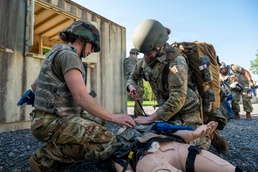
In trauma care, every second matters. For Airmen assigned to the 911th Aeromedical Evacuation Squadron, those seconds are often spent caring for patients aboard aircraft mid-flight. During a Tactical Combat Casualty Care Tier 3 course at Camp Dawson, West Virginia, May 11-18, 2026, Reservists and Guardsmen trained for scenarios they'd have to render aid under fire and on the battlefield.
The eight-day course brought 911th AES medical providers together with 167th AES instructors to practice treating casualties in the critical first minutes after injury — preparing Citizen Airmen to assess, stabilize and evacuate patients in austere, resource-limited environments.
Master Sgt. Loy Nelson, 167th AES aeromedical evacuation technician and instructor, said the Tier 3 course is designed specifically for medical providers and focuses on casualty care both on and off the battlefield.
“Combat medics, medics, nurses — anybody who is a medical provider,” Nelson said. “This course is eight days long and goes over a lot of things pertaining to combat and noncombat scenarios, and how to provide medical care to patients at the point of injury.”
Throughout the course, students practiced trauma care using the MARCH PAWS mnemonic sequence — Massive Hemorrhage, Airway, Respiration, Circulation, Head Injury, Hypothermia, Pain, Antibiotics, Wounds and Splinting — a treatment framework that guides medical providers through life-threatening injuries before moving to follow-on care.
The training included classroom instruction, hands-on skills practice and scenario-based training focused on hemorrhage control, airway management, wound packing, blood products, tactical trauma assessments, patient movement and casualty evacuation.
Master Sgt. Hannah Burtnett, 911th AES flight chief of clinical management, said the course helped prepare nurses and medical technicians for the early moments after a traumatic injury occurs.
“The goal of this course is to have medical providers be comfortable in a high level of stress in a trauma situation,” Burtnett said. “As nurses and medical technicians, we are very comfortable on the aircraft, but not necessarily in the initial trauma — minutes after trauma has occurred.”
Nelson said this type of training is increasingly important as aeromedical evacuation Airmen prepare for operational environments where casualties may require treatment closer to the point of injury.
“TCCC is important because, as the future fight evolves, we are doing more point-of-care services instead of picking up patients from dedicated medical facilities,” Nelson said. “Having the training and knowledge to treat severely wounded or injured patients at the point of injury, rather than in a hospital setting, prepares people for the future fight we may face.”
The course culminated in a scenario where students had to locate, assess, treat and move simulated casualties while working under pressure.
“There is a lot of information that has to be shared and learned together as a class,” Nelson said. “The course is about 50% in class and 50% hands-on, and ultimately it all boils down to a hands-on scenario where they will be put to the test.”
While the course challenged students technically and mentally, participants said the training also strengthened teamwork and confidence.
“I have learned a lot from this course,” Burtnett said. “My catchphrase is, be comfortable with being uncomfortable. When we go into the fight, we are going to be uncomfortable, but if we have tested ourselves before, we can rely on our muscle memory, let our training kick in and succeed in the end.”
The classroom, training lanes and a culminating scenario pushed students past routine care and into the decisions that define TCCC. For the 911th AES Airmen, the training reinforced a simple reality of trauma care: before a patient can be moved to a higher level of care, someone must be ready to act swiftly and decisively in the first critical moments after injury.