As a child in the Philippines, he remembers storms so loud they shook the walls. Typhoons tore through villages, flooded roads and forced families to rebuild with whatever remained. Volcanic eruptions darkened the sky with ash while monsoon floods swallowed entire neighborhoods. Those experiences taught him resilience early in life.
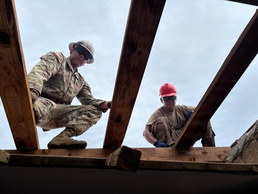
Years later, that same child now serves thousands of miles from home in uniform with the U.S. Army Reserve, deployed to Saipan. Today, he leads teams helping families recover from disaster by building temporary roofs that provide safety, comfort and peace of mind.
Chief Warrant Officer 3 Khristian Lee Viray serves as a temporary roofing planner with the 411th Engineer Battalion based at Fort Shafter, Hawaii. Since late April, he and other Reservists have supported emergency response operations in Saipan following Super Typhoon Sinlaku as part of the Army Reserve’s responsibilities under Defense Support of Civil Authorities (DSCA) and at the direction of the Federal Emergency Management Agency (FEMA) and the U.S. Army Corps of Engineers (USACE).
The USACE Honolulu District, in close partnership with the Commonwealth of the Northern Mariana Islands (CNMI) government, island Mayor’s offices, FEMA and the U.S Department of War, installed the first temporary roofs in Saipan, Tinian, and Rota, bringing immediate protection to storm-damaged homes.
Army Reserve teams support the Sustainment of Temporary Resilience and Operations Needs on Ground mission, known as STRONG Roof. The operation combines the efforts of U.S. Navy Seabees assigned to Combined Task Force 75 Detachment, soldiers from the 797th and 871st Engineer Vertical Construction Companies, and civilian contractors to accelerate roofing installations.
“Our efforts are divided into ten-person crews,” Viray said. “Our teams are led by noncommissioned officers and subject matter experts and work alongside soldiers with carpentry and engineering skills.”
Viray said crews categorize homes based on the estimated time and scope of work required. Teams classify minor-effort homes as projects they can complete within four hours or less. Homes requiring more extensive repairs fall into a second category that takes longer to complete.
Depending on weather conditions, damage severity and other factors, crews typically complete one or two homes each day. Their mission has ended and they worked on 50 Viray understands the emotional weight of disaster recovery because he lived through similar experiences growing up in the Philippines. After serving more than 20 years in the Army Reserve, he now helps others who have endured the same hardships he once faced.
“This is a great group of soldiers,” Viray said. “Many of them have dealt with personal pain during disasters and understand what this mission means to local families. When we can provide someone with a moment of peace and hope, that’s a good day.”
Several soldiers on Viray’s team come from Guam and survived Typhoon Mawar in 2023. Many responded immediately after the storm, putting on their uniforms to help rebuild their communities while managing damage to their own homes and neighborhoods.
1st Sgt. Edward Martinez, construction manager for the 797th Engineer Vertical Construction Company, remembers responding during the Guam recovery mission. With 20 years of service in the Army Reserve, he focused on helping others despite his own challenges.
“The least of my concerns was my personal situation,” Martinez said. “So many people needed help, and together with my Army team we could make a small difference. I wanted to help my fellow citizens who were in serious need.”
His unit was mobilized from June through late August 2023 to support FEMA, the Army Corps of Engineers and local governments by installing temporary roofs across Guam. much like the work they now perform in Saipan.
Their personal experiences, technical expertise and commitment to service show the quality of their work every day. For many of these soldiers, serving island communities affected by disaster represents both a duty and an honor.
Born and raised in Guam, Martinez takes emergency response seriously. Alongside his military service, he also serves as a FEMA reservist.
“Whether I serve in uniform with the Army or as a civilian with FEMA,” Martinez said, “I am going.”
As for Viray, currently working as a civilian senior project manager and quality control manager for a construction firm, he wants to come back to USACE.
Prior to his civilian job, he served with the USACE Transatlantic District as a project manager as part of Operation Inherent Resolve in Iraq and Syria. He took on a career broadening assignment into the civilian market but ultimately decided he wanted more.
He recently interviewed and accepted a position to return to the USACE Alaska District to be a program manager.
“I missed the stability, benefits and important mission to make a difference,” he said.
Viray, Martinez, and their fellow Soldiers continue demonstrating how service, resilience, and compassion come together during disaster recovery missions.