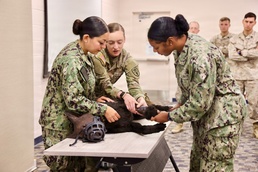
TWENTYNINE PALMS, Calif. — Hospital corpsmen assigned to Navy Medicine Readiness and Training Command (NMRTC) Twentynine Palms strengthened their operational medical capabilities in May 2026 through a Canine Tactical Combat Casualty Care (K9 TCCC) course taught by Army veterinary personnel, providing participants with specialized training designed to help save the lives of military working dogs in combat and field environments.
The course introduced corpsmen to the principles of canine battlefield medicine, including trauma assessment, hemorrhage control, airway management, heat injury recognition, patient stabilization and casualty evacuation considerations for military working dogs. The training marked the first time the course had been broadly offered to corpsmen across the command.
Military working dogs serve alongside service members throughout the Department of War, supporting missions ranging from explosives detection and force protection to law enforcement and patrol operations. Like their human counterparts, military working dogs can suffer injuries during training exercises, operational missions and emergency situations. When those incidents occur in austere environments, corpsmen may be the first medical providers available to render aid.
According to Army Spc. Amelia Knosp, an animal care specialist assigned to the Marine Corps Air Ground Combat Center Twentynine Palms veterinary clinic, providing corpsmen with canine trauma care skills helps bridge a critical gap between injury and definitive veterinary treatment.
“I think that it is very beneficial for hospital corpsmen to train in K9 TCCC because it is a great expansion of their skills and allows them the opportunity to learn something new,” said Knosp. “In a field environment, they will often be the first line of medical care. Animal care specialists and veterinarians are spread thin and are not usually going to be out in the field.”
Knosp explained that military working dog handlers and corpsmen may become the most important resource available to stabilize an injured canine until evacuation to a facility where veterinary personnel can assume care.
“The corpsmen and the dog handlers together will be the most valuable resource to save the canines’ lives until they can be evacuated to a field hospital, where there will more likely be veterinary staff to assist in their care,” she said.
The training itself grew from grassroots interest among NMRTC Twentynine Palms corpsmen seeking opportunities to expand their tactical medicine knowledge. What began as a proposed small-group session quickly evolved into a larger course after additional corpsmen expressed interest in participating.
“The training was arranged due to corpsmen requesting it,” said Knosp. “The original plan was to do a small course for those who were interested. However, more corpsmen found out and expressed increased interest, leading to a full course conducted in three different sessions.”
Knosp credited NMRTC Twentynine Palms' staff training and education department for helping coordinate the training, along with support from several corpsmen and officers.
Although canine casualty care was unfamiliar territory for many attendees, instructors noted that participants quickly adapted because of the similarities between K9 TCCC and standard TCCC principles corpsmen already employ when treating human casualties.
“The corpsmen did well, especially considering it was new information for all of them,” said Knosp. “They all came ready and excited to expand on their skills.”
Hospital Corpsman 3rd Class Jaeden Masse of Queen Creek, Arizona, said one of the most surprising aspects of the course was discovering how closely canine trauma treatment mirrors human casualty care.
“K9 TCCC is not far from the TCCC we use on our human patients,” said Masse. “I think it will apply to me as a corpsman in everyday use, even with my own animals at home or any PMO (Provost Marshall Office) K9s that may need help at any point.”
While many treatment concepts remained familiar, the course also highlighted important physiological differences between humans and canines that can influence treatment decisions.
“There were far more similarities than there were differences,” said Masse. “Some key differences are every dog is different between working and resting temperature compared to where all humans have a set threshold that we abide by for heat cases.”
In addition to classroom instruction, the training incorporated practical exercises and real-world examples from veterinary medicine. Masse said hearing firsthand experiences from instructors helped provide valuable context that cannot always be replicated through traditional training materials.
“They talked about some real-life experiences that most of us corpsmen may never see in our time on active duty,” he said.
One of the more challenging skills involved airway management procedures, particularly canine intubation under realistic conditions.
“The intubation while having a muzzled dog,” Masse said. “The tube size also varies per dog, so praying their handlers know their dog’s size could be challenging if not.”
The training also served as an example of the value of joint-service collaboration within military medicine. By bringing together Army veterinary specialists and Navy corpsmen, participants were able to share knowledge across service branches while building relationships that can improve coordination during real-world operations.
“I think the military as a whole can only improve when different branches and specialties work together and learn from each other,” said Knosp.
That interoperability remains a key component of military readiness across the force, particularly as service members increasingly operate in joint environments where success depends on seamless coordination between organizations, specialties, and services.
Military working dogs continue to play a vital role in supporting national defense missions worldwide. Ensuring that frontline medical personnel possess the knowledge and confidence to care for those animals during emergencies helps preserve a critical operational capability while reinforcing the bond between handlers and their canine partners.
“K9s play a big role in the military whether it's sniffing bombs or any sort of drug bust,” said Masse. “So, it’s only right to treat them like they're one of us.”
Masse encouraged fellow corpsmen to take advantage of similar opportunities whenever available.
“I would highly recommend doing K9 TCCC,” he said. “It just enhances your everyday knowledge.”
The collaboration between NMRTC Twentynine Palms and the installation veterinary clinic extends beyond the canine TCCC course. Knosp said the veterinary clinic has already assisted with a shadowing program that allows interested corpsmen to observe veterinary surgery days and gain exposure to procedures such as intravenous catheter placement, intubation, and dental treatments.
“In some cases, corpsmen have been allowed to help with these procedures when it is safe for the patient,” said Knosp.
As Navy Medicine and the Defense Health Agency continue to emphasize warfighter readiness and operational medical proficiency, training opportunities like K9 TCCC provide corpsmen with additional tools to respond effectively in complex environments, ensuring they are prepared to care for every member of the team — including those with four legs.