The Hawaiʻi National Guard (HING) has concluded a multi-month, statewide response at the end of May after providing extensive support to communities impacted by a series of powerful Kona Low storms and severe weather events in March and April 2026. The complex, multi-island mission, which at its peak saw as many as 500 Soldiers and Airmen on State Active Duty, transitioned from dramatic life-saving rescues to sustained recovery operations that continued until May 22, 2026.
The response began in mid-March with the first of three storm systems. The HING initially activated about 90 personnel, deploying High Water Vehicle Teams (HWVT) and embedding liaisons in county emergency operations centers.
During this first storm, Guard members evacuated 24 civilians from floodwaters on Hawaiʻi Island, assisted with dam observation on Oʻahu and managed traffic control points on Maui.
A week later the mission escalated with the arrival of a second, more powerful Kona Low storm, which increased the number of activated personnel to around 200. This phase was defined by critical rescue operations on Oʻahu, where HWVTs conducted ground rescues for 91 people, and UH-60 Black Hawk helicopters airlifted another 47 adults, children and two dogs to safety from the Waiʻanae area. The Guard’s 93rd Chemical, Biological, Radiological, Nuclear and Explosive Enhanced Response Force Package assisted with search and extraction operations in the first days after the storm on the North Shore of Oʻahu.
“Our Soldiers and Airmen answered the call to service, putting community first in support of response and recovery efforts during these back-to-back-to-back storms,” said Maj. Gen. Stephen F. Logan, the adjutant general for the state of Hawaiʻi. “Their commitment to helping neighbors in need, reflects their dedication to help families and communities begin recovery.”
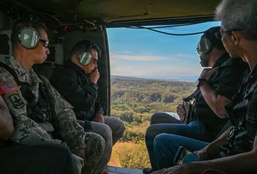
As the immediate flood threats from the March storms subsided, the mission transitioned to recovery. Guard members assisted Maui County with 68 damage assessments, including an aerial survey of Molokaʻi for Maui Mayor Richard Bissen.
On Oʻahu, the focus shifted to debris removal and providing essential services. Guard teams began clearing debris and distributing potable water to communities on the North Shore.
The operational tempo remained high into early April, as Guard members prepared for a third storm system while continuing recovery work. More than 4,400 sandbags were filled and distributed to protect communities, and response assets were staged statewide.
“Across the state, we’ve called on our citizen soldiers and airmen to be ready to assist first responders and protect our communities,” said Brig. Gen. Tyson Tahara, acting director of the HING Joint Staff, during the April preparations. “We continued to maintain strong coordination with our county emergency management partners to provide disaster relief.”
The final phase of the mission involved continued support for Oʻahu residents affected by a boil-water notice in the Waialua area. A team of 130 personnel managed bulk potable water distribution points at Otake and Mill Camps, a mission that continued until demobilization at the end of May.
Meanwhile, support on Maui officially concluded in late April, with the Molokaʻi Armory being provided to the Maui Emergency Management Agency to serve as a long-term community resiliency hub.
By the conclusion of the activation, the Hawaiʻi National Guard had: · Rescued or evacuated 138 civilians by air and ground. · Distributed over 42,000 gallons of potable water to over 3,200 residents. · Cleared 3,732 cubic yards of debris from 164 homes.