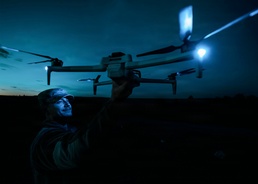
MARCH AIR RESERVE BASE, Calif.— U.S. Air Force Maj. Adam Lucero, director of innovation for the 163d Attack Wing’s Hap Arnold Innovation Center, was selected to provide direct operational insight to the California Military Department working group and the Governors’ working group led by U.S. Army Maj. Gen. Matthew Beevers, The Adjutant General of the California Military Department. The working groups, in coordination with Joint Staff partners, focused on identifying challenges and developing solutions to counter small Unmanned Aircraft Systems (sUAS) threats across California. Discussions include strengthening protections for critical infrastructure, military installations, and public safety through broader sUAS regulations, controls, and emerging technologies.
“Having a direct voice in these strategic discussions alongside Maj. Gen. Beevers and the Joint Staff is a testament to the specialized expertise resident within our wing,” said U.S. Air Force Col. Joshua Assayag, commander of the 163d Attack Wing. “The small UAS threat is evolving rapidly, and it requires agile, forward-thinking solutions. By bringing our Airmen’s innovative concepts to the Governor’s Working Group, we help ensure California proactively shapes robust defenses for critical infrastructure rather than reacting after the threat emerges.”
In coordination with the working groups, Lucero is developing a playbook of available counter-UAS technologies and best practices designed to harden critical infrastructure and military bases. The effort aims to reduce duplication, accelerate implementation timelines, and improve coordination across the state and the National Guard Bureau.
“The 163d is leaning forward by translating our extensive operational experience into actionable counter-UAS strategies,” Assayag said. “We are proactively developing concepts to safeguard military assets and the general population alike. This partnership at the state level helps inform broader regulations and controls, ensuring the 163d's tactical innovation directly contributes to California’s overall safety and security.”
The Hap Arnold Innovation Center serves as a hub for collaboration between military, government, and interagency partners. Solutions developed locally by the 163d are rapidly shared through networks extending across the National Guard Bureau and Joint Interagency Task Force-401.
JIATF-401 is a specialized Army-led Department of Defense organization established in August 2025 to rapidly develop, test, and field cUAS technologies in Defense of the Homeland. Technologies under consideration for cUAS operations include microwave, directed-energy, kinetic interventions, radio-frequency detection and jamming capabilities, radar, acoustic sensing, and advanced optical tracking. Systems already supporting operational missions across the state, such as mobile platforms that integrate radar, radio frequency, and optical sUAS detection capabilities, demonstrate the immediate value of a layered defense.
The growing need for effective cUAS solutions has become increasingly apparent during emergency response operations. During the Palisades Fire response, unauthorized sUAS activity disrupted manned aircraft operations supporting firefighting efforts, delaying critical aerial response capabilities and highlighting the operational risks posed by uncoordinated drone activity.
“Any time a new technology reshapes our lives, there is an adjustment period for policies, authorities, and employment into operations. Our goal at the HAIC is to help ensure that our rapid and successful implementation of both offensive and defensive capabilities in California are shared, making us stronger across the entire joint force,” said Lucero.
The 163d Attack Wing continues to advance innovative, operationally relevant solutions that strengthen the Defense of the Homeland and support joint-force readiness in an increasingly complex threat environment. By spearheading these collaborative strategies, the wing directly reinforces the Department of the Air Force's unwavering commitment to ensuring our installations and critical infrastructure remain secure, ready, and equipped to protect against potential sUAS incursions.