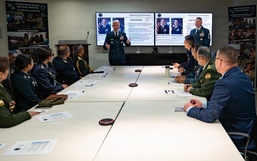
The International Health Specialist Program Office and Air Force Medical Service leaders hosted nine international senior medical officers from eight major allies and partners to showcase the IHS program and global health engagement efforts at the Defense Health Headquarters, Falls Church, Virginia.
The visit featured officers from Czech Republic, Egypt, India, Japan, Jordan, Malaysia, the Philippines and Taiwan enrolled in the Advanced Aerospace Medicine International Medical Officers course, or AAMIMO, offered through the U.S. Air Force School of Aerospace Medicine.
AAMIMO, an annual 23-week course, is a medical security cooperation initiative that aims to enhance global health engagement and U.S. partnerships through education and training, according to U.S. Air Force Col. Steven Nordeen, AAMIMO course director. The course prepares international students for a medical leadership career in their respective militaries while establishing early collaboration and knowledge exchange based on mutual interests.
“The objective is to increase interoperability and maximize support to the warfighters,” he said. “[It] secures working relationships with international senior medical leaders.”
AFMS medical leaders briefed the international students on the Air Force Surgeon General’s policy and resourcing for medical initiatives, efforts to expand Space Force medicine research, and the Department of the Air Force’s mental health approach for Airmen and Guardians.
U.S. Air Force Col. Heleno Souza, IHS program deputy director, said the program enhances crisis response and readiness among engaged partner nations, helping build capability and interoperability. He said the results in “proactive regional stability.”
“[Our partners] become more effective at what they do when we are facing a type of adversity,” Souza said. “They can utilize that capability, specific to meet their needs, to enhance their approach, systems, and their readiness.”
U.S. Air Force Lt. Col. Brad Kennedy, chief of domestic medical plans and operations for the National Guard Bureau, Office of the Joint Surgeon, described how state partnership programs involving the Army and Air National Guard strengthened civilian-military partnerships as well as relationships with partner nations.
Kennedy shared examples of humanitarian and civic assistance, including a portion of Exercise African Lion 26 in which the Utah National Guard and the Royal Moroccan Armed Forces conducted a joint humanitarian civic assistance mission, treating an estimated 20,000 patients in 11 days.
AFMS leaders also described the future integration of space into global health engagement efforts as the U.S. Space Force continues to grow its mission set.
U.S. Air Force Col. Jeffrey Kinard, IHS liaison to the USSF, framed space medicine as an environment rich with opportunity for international collaboration. He said given that space medicine practitioners are a niche community, there is strong value in developing space technologies - such as environmental monitoring, disaster response and infectious disease surveillance - as collective solutions for global challenges.
Each briefing fostered dialogue between AFMS medical leaders and the international senior medical officers, concluding with some exchange of tokens of appreciation.