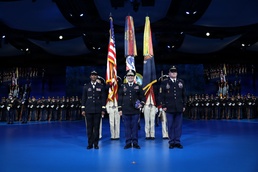
WASHINGTON – Command Chief Warrant Officer 5 James Richards, formerly the Command Chief Warrant Officer for the 780th Military Intelligence Brigade (Cyber), retired after more than 24 years of Army service in a Department of the Army Retirement Ceremony in Conmy Hall on the historic installation, Joint Base Myer-Henderson Hall, May 14, 2026.
CW5 Richards hails from Glendora, California, and enlisted into the 311th Theater Signal Command, U.S. Army Reserve on March 20, 2002, at Fort George G. Meade Military Entrance Processing Station. Richards received his commission as a second lieutenant from the U.S. Officer Candidate School on December 4, 2002; and attained a BA in Computer Science from Cornell University in 2002. He resigned his commission and received a direct appointment as a warrant officer on August 18, 2006, while serving in the Delaware Army National Guard.
“His achievements leave a legacy of enabling the Cyber Mission Forces (CMF) and the U.S. Department of War (DOW) cyber enterprise to achieve historic milestones, unlock the force’s potential to act, and build a path for individuals of all Services to reach their full potential,” said COL Candy Boparai, commander of the 780th MI Brigade (Cyber). “CW5 Richards was a pioneer and trailblazer in U.S. Cyber Command (USCYBERCOM), establishing or directing the creation and first use of many elements of the Cyberspace Operations enterprise that are routinely employed today.”
In 2016, CW5 Richards was the mission commander for one of the first USCYBERCOM missions that exercised two of the military cyberspace collection authorities, enabling thousands of operations per year since then. He also designed the initial oversight training for one of those authorities, permitting the CMF to proliferate use of the authority across the enterprise. He guided the operational design of multiple cyberspace operations campaigns. Additionally, in 2020 he was the tactical planner for the first cyberspace effects operation conducted by a Cyber National Mission Force (CNMF) Joint Task Force which involved three crews of people executing operations for more than 60 hours. Outside of operations, during his time as a Mission Director in USCYBERCOM’s J3 (operations), he led efforts to establish policy that more closely included allied personnel as full participants in the enterprise, employ multiple authorities simultaneously on the same operation, allow Information Operations to leverage the full range of permissible actions under cyberspace operations, and leverage master-level members of the CMF to individually assess and mitigate previously unknown risk while on operation.
His leadership during the formative years of USCYBERCOM helped create the conditions for it to mature its own platforms and routinely execute operations that blend known uses of authorities with disciplined risk acceptance to maintain the DOW’s strategic overmatch against our adversaries.
CW5 Richards was a steward and builder of the CMF’s workroles, CMF training, and the Army’s implementation of them. In 2018, he was one of the architects of the first revisions in the qualification standard for two workroles since their establishment: Mission Commander and Exploitation Analyst. Additionally, with a small group across the CMF, he rebuilt the Mission Commander Course (MCC) to include modern elements of cyberspace operations, authoring three out of 18 modules personally and training over 400 Mission Commanders over the next six years as one of the primary instructors for the course. The course additionally served as the basis for Mission Commander training that is conducted at the U.S. Army Cyber School, Fort Gordon, Georgia, today. To bring these and other CMF workroles into the Army’s personnel systems, he also worked with multiple elements at U.S. Army Cyber Command and the Cyber Center of Excellence over the course of more than six years to establish a series of Primary Developmental Skill Identifiers (PDSI) and modernize the Cyber Assignment Incentive Pay (CAIP) program, culminating in a major corrective revision in April 2025 that brought the programs in line with current CMF workroles and readiness requirements. In conjunction with those changes, he championed the expansion of utilization tours for recipients of Training With Industry (TWI) and Advanced Civil Schooling (ACS) benefits from approximately five positions across 780th MI Brigade (Cyber) to more than 25, covering every location the Brigade has personnel for the first time in its history. Also, during his tenure as the first Army warrant officer (WO) to serve as a Mission Director in the USCYBERCOM J3, he refined the qualification standard for that role and trained the next four Mission Directors, including the next two Army WOs to hold the role.
Beyond his work within the Cyberspace Operations enterprise, CW5 Richards contributed his expertise to strategic efforts. From 2021 to 2024, he was one of three Cyberspace Operations advisors to the Office of Net Assessment’s global exploratory exercise series, and one of the designers of its mechanism to incorporate cyberspace effects into those exercises. Leveraging more than eight years as a plankholder in the Army’s Cyber Warrant Officer Cohort, from 2022-2024 he advised the Headquarters, Department of the Air Force, A1 and the 16th Air Force as it re-established Warrant Officers in the US Air Force, culminating in the first 30 US Air Force Warrant Officers being appointed in over 66 years at Maxwell Air Force Base in December 2024.
“From CMF Team to Combatant Command, and from the classroom to the operations floor, CW5 Richards’ leadership and expertise have left a lasting impact on the Cyber Mission Forces, the DOW Cyberspace Operations enterprise, and the US Army,” said Boparai.
CW5 Richards may be leaving the Praetorian and Army family; however, his legacy and impact will be remembered in the years to come.
“24 years in the Army taught me that helping others is not a zero-sum game. Throughout your career, people will lift you up so you can go back and lift others up yourself,” said CW5 Richards. “Use the chances they give you to understand other people – even the ones who oppose you – and you might find that they are just the kind of people you want to help, and not adversaries at all.”
“Ubique Et Semper In Pugna”
“Everywhere and Always...In the Fight!”