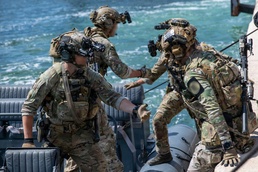
BAUMHOLDER, Germany – Across Europe, from the Black Sea to the Balkans and from Greece to the Baltics, approximately 2,000 special operations forces and 1,000 other service members from 23 nations trained together in 10 countries in a major biennial exercise.
Trojan Footprint is amultinational, joint-combined exercise and the largest special operations forces exercise in the European theater in which the U.S. participates.
“The overarching purpose of Trojan Footprint is to demonstrate a competent, credible, SOF capability to defend every inch of the alliance,” said U.S. Army Lt. Gen. Richard E. Angle, commanding general of U.S. Special Operations Command Europe and NATO Allied Special Operations Forces Command. “This exercise ensures that through shared expertise and applied lessons learned, every participating nation emerges stronger, more agile, and completely unified in our collective defense.”
Forces from Bulgaria, Croatia, Estonia, Georgia, Germany, Greece, Hungary, Latvia, Lithuania, North Macedonia, Poland, Romania, and the United States participated in the exercise, which lasted for two weeks.
“It really gives us the opportunity to show that we’re combat credible and to build interoperability between those forces to ensure that, if required, we can operate seamlessly together in any type of environment,” said Angle. “Working together builds trust, it builds cohesion, and it allows us to test a lot of new capabilities.”
Angle explained that Trojan Footprint presented an opportunity for the United States and European allies to take the lessons being learned in Ukraine and apply them in a demanding environment.
“Our adversaries should look at this and see our ability to bring combat-credible capability together at a scale that can defend every inch of the alliance,” he said. “We continue to build on the generational relationships we have here in Europe, that builds a trust that really allows us to move at the speed of relevance.”
In the U.S. Army Special Forces, a 12-man team, or Special Forces Operational Detachment (SFOD), is the basic fighting force of the Green Berets. In the Balkan region, Green Berets with U.S. Army 20th Special Forces Group (Airborne)trained side-by-side with Greek and North Macedonian special forces in high-stress scenarios simulating responses to a crisis or conflict in that region.
“We did a lot of close-quarters combat drills, practiced moving through rugged terrain, and ran mock missions,” said a Green Beret team commander with 20th SFG(A). “The whole point was to make sure that if things ever hit the fan for real, we already know exactly how to fight next to each other on the same battlefield.”
Interoperability between different nations and among different components within each nation is a key goal for exercises like Trojan Footprint.
According to the team commander, interoperability means playing well in the figurative sandbox together. “Imagine if you and I tried to build a deck in your backyard, but you only spoke Greek, I only spoke English, and we brought completely different sets of tools,” he said. “It would be a mess. It’s making sure our radios can actually talk to their radios, that we understand their hand signals, and they understand our tactics. When we worked with the Greeks and North Macedonians, the goal was to sync up our gear and our mindset.”
According to him, the tactical training in this exercise is great, but the downtime after the weapons are cleared is just as valuable and is when trust and rapport really grow.
“For Green Berets, building relationships is our bread and butter,” he said. “One night after a long field exercise, the Greek guys brought out some of their local food, and we just sat around trading stories, joking around, and swapping unit patches. You quickly realize that even though they wear a different flag on their shoulder, they are the exact same kind of guys we are; hardworking, dedicated, and proud of their countries.”
Trojan Footprint 26 demonstrated the lethality of NATO SOF deterrence, projecting the collective will and capability to defend the alliance in a rapidly evolving technological threat environment.
This evolving technological capability is exemplified by the growing role of the U.S. Space Force in SOF operations, particularly the Tactical Surveillance, Reconnaissance and Tracking, or TacSRT, and GPS and GNSS jamming.
“When we think about what space is offering SOF enterprise and our allies and partners throughout Exercise Trojan Footprint, we understand that our adversaries are providing a denied, degraded and contested environment,” said U.S. Space Force Maj. Edward Tabbutt, Trojan Footprint 26 effects cell chief. “This is the current environment we face. Our Space Force Guardians will be providing the opportunity to better understand the capabilities we can bring to the fight.”
Among the most significant advancements demonstrated during Trojan Footprint 26 was the integration of cutting-edge autonomous technology designed to solve the critical challenge of contested logistics. The exercise served as the operational debut in the European theater for the Long-Range Grasshopper, an expendable, low-cost cargo glider capable of delivering 500-pound payloads over hundreds of miles.
By executing successful precision drops in both Romania and North Macedonia, special operations planners proved that the joint force can sustain isolated units in high-threat environments without risking lives of manned resupply crews.
This milestone underscored a broader shift within NATO toward unmanned sustainment. The seamless execution of the Grasshopper flights required intense multi-domain coordination between SOCEUR logisticians, commercial engineers, and allied partners on the ground.
As Trojan Footprint 26 concludes, the integration of these autonomous systems stands as an example of how the alliance is actively transforming to maintain operational agility on the modern battlefield.
“We have incredibly capable allies in special operations in all domains,” Angle said. “They have techniques, tactics and procedures based on their environments that we can learn from, and we have things we can teach them.”
Since its inception in 2016, Trojan Footprint 2026 has evolved into the premier and largest SOF-led exercise in Europe. As a routine biennial Large-Scale Global Exercise, Trojan Footprint 2026 integrates the U.S. Air Force, Army, Marine Corps, Navy, and Space Force with Allied nations, demonstrating the multinational cooperation required to maintain ready and credible forces.
Ultimately, Trojan Footprint 2026 postures resilient forces to deter aggression and defend regional security, serving as a testament to the credible partnerships essential for safeguarding the common interests of all participating nations.
For more information about Trojan Footprint 2026, contact the U.S. Special Operations Command Europe Public Affairs Office at +49 (0) 711-7073-4048, or via email at mailto:SOCEURListPAOALL@socom.mil
For information, imagery and downloadable content visit SOCEUR social media and Defense Visual Information Distribution Service (DVIDS).