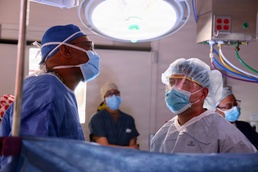
TWENTYNINE PALMS, Calif. — Naval Hospital Twentynine Palms and Weed Army Community Hospital at Fort Irwin launched a new joint training partnership on April 27, 2026 designed to strengthen combat medical readiness, expand clinical training opportunities, and enhance interoperability between Army and Navy medical personnel across the Military Health System.
The Joint Medical Augmentation and Skills Training (JMAST) Program formally establishes a collaborative framework allowing Sailors and Soldiers to train together through shared clinical rotations, surgical support opportunities, trauma simulations, and operational readiness exercises. Leaders from both military treatment facilities (MTFs) say the partnership reflects a broader Department of War effort to integrate medical capabilities across the joint force while ensuring military medical personnel remain clinically proficient and prepared for operational environments.
“The partnership we now have with Weed Army Community Hospital (WACH) at Fort Irwin is focused on competency and skills sustainment and training opportunities between both commands,” said Lt. Cmdr. Joy Michelle Dizon, department head for the main operating room and sterile processing department at Naval Hospital Twentynine Palms (NHTP). “They send surgical technicians and operating room nurses here to Navy Medicine Readiness and Training Command (NMRTC) Twentynine Palms for skills sustainment through the services and surgical cases we provide, and in return, they offer us valuable training opportunities.”
The initiative supports Assistant Secretary of Defense for Health Affairs Dr. Keith Bass’ emphasis on partnerships as force multipliers throughout the Military Health System by encouraging greater collaboration between military and federal healthcare organizations to improve readiness, sustain clinical skills, and deliver high-quality care. It also aligns with Defense Health Agency Director Vice Adm. Darin Via’s focus on delivering integrated joint warfighting medical capabilities through seamless cooperation across all branches of service.
For military medical personnel assigned to lower-volume facilities, maintaining procedural repetition and operational experience can present challenges. Leaders at both organizations identified an opportunity to close that gap by pooling resources and creating recurring cross-service training opportunities.
Before assuming her current leadership role, Dizon said her predecessor, Lt. Cmdr. Lauren Bond, encouraged continued collaboration with WACH leadership to build a long-term relationship focused on mutual support during staffing shortages and operational demands. After connecting with Army leaders, the program quickly gained momentum.
“Shortly after I reached out, I received a response from Lt. Col. JoAnn LeDoux, chief of surgical services at WACH,” Dizon said. “Together, we developed a plan for onboarding and training, which we presented to our immediate leadership.”
The proposal received support from command leadership at both facilities. Dizon credited Cmdr. Stacie Groves, who at the time served as director of surgical services at NHTP, for helping guide the program through the approval process and advocating for the initiative with senior leadership. The program was quickly signed into action by WACH commander Col. F. Cameron Jackson and NHTP director and NMRTC Twentynine Palms commanding officer Capt. Janiese Cleckley, formally establishing the JMAST Program.
Cleckley emphasized the importance of strengthening connections between geographically separated MTFs.
“In environments like ours, the tyranny of distance can’t be a barrier — it has to be a bridge,” Cleckley explained. “By sharing resources, expertise, and training opportunities, we create a stronger, more agile medical force that ensures our service members receive the right care at the right time — ultimately keeping the warfighter in the fight.”
The partnership extends beyond traditional hospital rotations. In March, Sailors from NHTP participated in a trauma readiness sustainment exercise hosted at WACH focused on high-pressure combat casualty care scenarios.
The simulation centered on a trauma patient with an unknown abdominal injury requiring rapid assessment, hemorrhage control, emergency surgical intervention, and patient stabilization for evacuation. The multidisciplinary team included combat medics, surgical technicians, trauma surgeons, and operating room personnel working together under simulated operational stress.
Training objectives included reinforcing trauma leadership roles, improving communication protocols, increasing familiarity with trauma equipment and operating room workflows, and enhancing proficiency in critical procedures such as cricothyroidotomy and chest tube placement.
By the end of the exercise, participants conducted detailed debriefs focused on improving efficiency, strengthening confidence among surgical staff, and enhancing interagency collaboration between the Army and Navy medical teams. Organizers said the training directly supported installation mission requirements and improved the teams’ ability to provide lifesaving care in austere or combat environments.
One of the first Soldiers to participate in the new partnership was Sgt. 1st Class Norris R. Sayviseth, noncommissioned officer-in-charge of surgical services at WACH.
Sayviseth, a native of Pittsburg, California, completed a weeklong rotation at NHTP from May 4-8, where he worked alongside Sailors in the main operating room and sterile processing department while participating in surgical cases designed to maintain and sharpen clinical skills.
“I came to support NHTP through a collaborative training program established between our commands,” Sayviseth said. “Since we have a lower surgical caseload at our primary facility, this initiative allows our nurses and surgical technicians to train and keep their skills sharp.”
Sayviseth said he immediately recognized the value of the opportunity when it was presented.
“It is an excellent way for our team to gain hands-on experience, increase our surgical exposure, and ensure we remain fully proficient in our roles,” he said.
Although the partnership marked a new formal agreement between the two organizations, Sayviseth said the transition into a Navy medical environment felt familiar due to previous joint-service experience at Walter Reed National Military Medical Center.
“I’m very familiar with Navy culture,” Sayviseth said. “There wasn’t any difference on how the Navy operated in the surgical suites. Surgical tech school is now integrated with the Army, Navy, and Air Force. The standard of training is pretty much the same.”
Dizon described Sayviseth’s rotation as a major success and said his participation validated the value of the program for both organizations.
“Overall, the experience was a tremendous success,” Dizon said. “He shared that junior Soldiers would greatly benefit from rotating through our command because the surgical cases we perform here provide valuable exposure, and repetition is essential for maintaining and strengthening clinical skills.”
During the rotation, Sayviseth worked throughout the operating room and sterile processing department to better understand NHTP’s workflows and surgical operations. He scrubbed into surgical cases and supported the surgical team while exchanging knowledge and best practices with Navy personnel.
NHTP staff coordinated extensive onboarding support to ensure a smooth integration into the command so visiting Soldiers can fully focus on the surgeries they are there to support. Sayviseth said the collaborative environment left a lasting impression.
“The Sailors I worked with during my rotation were exceptional,” he said. “They were courteous and respectful. They made me feel welcomed and supported anything I needed during my stay.”
Beyond individual training opportunities, service members from both commands say the partnership represents a broader shift toward integrated military medicine designed to maximize readiness across the joint force.
“The new agreement between NHTP and WACH establishes an exceptional framework for inter-service synergy,” Sayviseth said. “This collaboration is a vital component of our readiness strategy, as it leverages the strengths of both MTFs to ensure clinical currency.”
He added that partnerships like JMAST help create long-term professional development opportunities while directly improving operational readiness for future deployments and assignments.
“By fostering this ongoing partnership, we are creating a sustainable pipeline for professional development that directly bolsters the mission readiness of both our Soldiers and Sailors,” he said.
Dizon said the long-term vision for the partnership extends well beyond the operating room and may eventually expand to additional departments and specialties across both hospitals.
“The goal of the program is to support one another during staffing shortages while expanding opportunities for skills sustainment and operational training,” Dizon said. “We also hope to eventually extend the program to additional hospital staff who may benefit from the clinical exposure at NHTP and the training opportunities available at WACH.”
As the Military Health System continues emphasizing joint readiness and operational integration, leaders at both facilities believe programs like JMAST demonstrate how local partnerships can produce strategic effects across the force.
“Collaboration with our joint partners at WACH is imperative to readiness and represents a significant step toward building a long-lasting partnership,” Dizon said. “Opportunities like this allow us to learn from one another, strengthen interoperability, and train together toward a common mission and goal.”