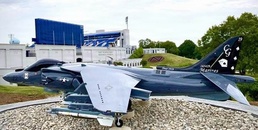
ANNAPOLIS, Md. -- An AV-8B Harrier II, BuNo 165429, now stands sentinel outside Navy-Marine Corps Memorial Stadium, the newest and one of the most symbolically charged static displays ever placed at the United States Naval Academy.
Painted in the colors of VMA-231 "Ace of Spades" and dedicated as a permanent tribute to Marine Corps Aviation, the aircraft was assembled on site the evening of May 7 with ordnance loaded May 10. A formal dedication ceremony will be announced at a later date.
More than a static display, the aircraft is a curated timeline of Marine Corps Aviation, every marking intentionally selected to tell the story of where Marine aviation began and how it evolved into the force it is today.
A Paint Scheme That Tells the Story:
The aircraft wears the markings of VMA‑231 “Ace of Spades,” the oldest squadron in the Marine Corps. The Ace of Spades insignia, designed by 2nd Lt Hayne D. Boyden, uses the ace to signify “First,” with the letters “A” and “S” representing “Air Squadron.” It was the first official unit insignia in Marine Corps aviation.
Below the canopy is the name 1st Lt Alfred Austell Cunningham, Marine Corps Aviator No. 1. On May 16, 1912, Cunningham received orders detaching him from the Marine Barracks and assigning him to the Naval Academy’s aviation camp. He reported six days later — a date now recognized as the birthday of Marine Corps Aviation — and was designated Naval Aviator No. 5 on Sept. 17, 1915.
The tail and flap numbering carries that history forward. Modex 19 was selected because the same “19” appears on the flaps; when viewed from behind, the aircraft reads 1919, the first year Marine Corps Aviation became an organized force. The black “CG” and spade motif on the tail are drawn directly from VMA‑231 heritage paint.
From the tail to the nose, this Harrier is a flying timeline of Marine Corps Aviation, placed at the very ground where it began.
How the Project Came Together:
The project originated inside the AV‑8B Harrier Program Office (PMA-257), the office responsible for sundowning the AV‑8B fleet and ensuring legacy airframes find permanent homes. It began as an idea between retired Gunnery Sgt. Pablo “Louie” Sanchez, AV-8B Assistant Program Manager for Logistics, and Dania Malveo, PMA‑257 Program Transition IPT lead, working through the PMA‑257 Harrier Museum Task Force, the standing body that coordinates the disposition of retiring Harriers to museums, memorials, and static displays across the country and internationally.
From that initial concept, a coalition formed:
In addition to these principal contributors, numerous individuals across the Naval Academy, NAAA, Fleet Readiness Center-East and VMA-231 supported the project through site approvals, coordination, aircraft preparation, and on-the-ground assistance. Their combined efforts ensured the aircraft could be transported, assembled, and displayed safely and in accordance with Academy standards.
A Harrier Pilot's Project:
For Deforge, Executive Director of the MCAA, the installation of an AV‑8B Harrier at Navy–Marine Corps Memorial Stadium carries personal meaning. A former AV‑8B Harrier pilot, Deforge served in both VMA‑231 and VMA‑513, flew combat missions out of Saudi Arabia during Operation Desert Storm, and later trained the next generation of Harrier pilots as an instructor at VMAT‑203. His son later followed in his footsteps and went through flight school in the T‑45 Goshawk and happened to be on a training flight during one of Deforge’s visits to Yuma while he was serving as commanding officer of VMA‑513.
In his professional capacity, Deforge leads MCAA in its mission to preserve and promote Marine Corps Aviation heritage. MCAA’s funding of the Annapolis Harrier display reflects that organizational mission and long‑standing commitment to aviation history. His personal background simply mirrors the deep connection many Marines feel toward the Harrier community and the legacy this display represents.
Why It Matters:
Static displays of retiring Marine Corps aircraft are more than memorial pieces, they are recruiting tools, history lessons, and identity markers, especially when placed where future officers train and assemble. Positioning an AV‑8B Harrier outside Navy–Marine Corps Memorial Stadium, bearing the name of the Marine Corps’ first aviator, who received his first orders to fly at Annapolis, it closes a loop more than a century in the making.