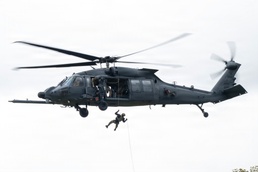
FRANCIS S. GABRESKI AIR NATIONAL GUARD BASE, N.Y. — More than 1,000 Airmen assigned to the 106th Rescue Wing completed a five-day combat readiness exercise, testing every element of the unit's operations and personnel recovery and combat support capabilities across two geographically separated locations May 12 to 16, 2026.
Exercise Northern Horizon, which involved all subordinate squadrons of the wing, was conducted at Francis S. Gabreski Air National Guard Base in Westhampton Beach, N.Y., and Fort Drum, N.Y., home of the Army's 10th Mountain Division.
Planners designed the exercise to validate the wing's readiness to execute its federal combat search and rescue mission under realistic, high-stress, and operationally challenging conditions. Participants trained continuously across day and night shifts, with scenarios incorporating simulated combat environments, medical emergencies, security breaches and coordination with Army medical personnel at Fort Drum's expansive training areas.
“Our goal going into this thing was to really test our wing, to check our readiness, to give our Airmen the opportunity to get the reps and sets in that they need before they find themselves in a similar situation down range,” said Col. Jeffrey Cannet, commander of the 106 Rescue Wing.
Aircrews from the 101st Rescue Squadron flew HH-60W Jolly Green II helicopters in simulated personnel recovery missions, launched from F.S. Gabreski and forward-operating scenarios staged at Fort Drum. Helicopter crews flew sorties, refining navigation, rescue operations, and austere landing zone procedures throughout the exercise.
"We were tasked with a homeland defense scenario to provide rescue forces to Northern Command," said Lt. Col. James Liston, commander of the 101st Rescue Squadron and served as the Personnel Recovery Task Force Commander at Fort Drum, throughout the exercise.
"We started with some call for fire events, live fire, live gunnery," Liston said. "We also conducted personnel recovery integration training with our Guardian Angel team."
Pararescuemen of the 103rd Rescue Squadron operated alongside combat rescue officers and air crews, executing recovery tasks at Fort Drum. Teams rehearsed isolated personnel recovery, field trauma care, and tactical movement to landing zones, reinforcing the Guardian Angel concept that pairs pararescuemen with combat rescue officers during recovery missions.
"We tested our ability to pack up, deploy, set up and execute missions," said MSgt. Wes Loignon, a pararescueman with the 106th Rescue Wing. "We ran a couple of different scenarios where we had to recover pilots who had ejected."
Aircrews of the 102nd Rescue Squadron flew HC-130J Combat King II aircraft in command-and-control roles while providing overwatch for recovery missions. Crews also transported over 100 Airmen to and from both areas of operation.
The 106th Maintenance Group kept aircraft mission capable throughout the exercise, with crew chiefs and aircraft maintainers working around the clock to meet mission requirements. Maintainers also deployed a forward maintenance element to Fort Drum, practicing expeditionary repair and aircraft turnaround procedures.
The 106th Medical Group established a forward operating aid station at Fort Drum that received simulated casualties, processing patients through triage and stabilization. Army medics embedded with the 41st Engineer Battalion, 10th Mountain Division, participated alongside 106th Medical Group Airmen.
Medical also had tests of endurance, adaptability and medical proficiency. Teams cycled through scenarios with each iteration requiring them to assess and move simulated casualties through a set of obstacles, including a water crossing, a six-foot wall, barbed wire and a bridge.
Airmen of the 106th Security Forces Squadron defended base assets and personnel at both locations. They faced several simulated trespassing and attack scenarios including an unmanned aircraft, or drone, attack and an active-shooter drill.
Wing intelligence personnel built and disseminated threat briefings and mission planning products, while communications specialists maintained secure network operations along with voice and data links between F.S. Gabreski and Fort Drum throughout operations. Logistics readiness Airmen managed fuel accountability, transportation, and supply chains that sustained the geographically split operation.
Officials from the Inspector General’s office observed the exercise events to assess and compile a review to identify training gaps and informs future readiness events.
Wing leadership indicated a strong performance across the force.
“Everyone had a piece of the mission and everyone succeeded,” said Command Chief Master Sgt. Edward Rittberg, senior enlisted leader of the 106th Rescue Wing. “We couldn't be happier with the way it turned out, and we're proud of every Airman on this installation.”
The 106th Rescue Wing, based at Francis S. Gabreski Air National Guard Base in Westhampton Beach, New York, operates and maintains the HC-130J Combat King II search and rescue aircraft, and the HH-60W Jolly Green II search and rescue helicopter. The 106th Rescue Wing is home to a special warfare squadron with pararescuemen and combat rescue officers, specializing in rescue and recovery, and deploys for domestic and overseas operations.