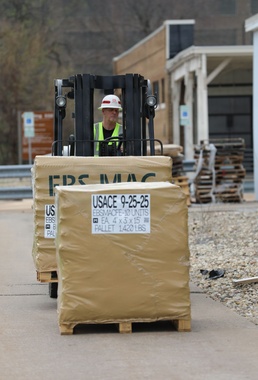
Responding to a flood fight mission is never an easy task. However, for U.S. Army Corps of Engineers, Rock Island District’s National Flood Fight Material Center Program Manager Cory Haberman, it is part of the job.
“My day-to-day operation is to provide supplemental flood fight equipment to USACE districts that may be experiencing flood events or have experienced flood events and need to restock or reset those materials,” Haberman said. “We provide assistance during an event, too.”
His latest weeklong deployment to Juneau, Alaska, was a fitting one.
“Juneau, Alaska, has a situation on the Mendenhall River,” he said. “There is a glacier basin called Suicide Basin that fills with water. In late July or early August, the glacial plug releases, and a large volume of water is released at once into Mendenhall Lake. This (surge of) water runs under a small bridge and then floods parts of Juneau.”
The deployment had been in development for some time.
“In the 2024 flood, there was a presidential declaration. After that, the governor requested advance measures of assistance. That means, as part of our flood control and coastal emergency authority, we can build temporary structures for what is known as an imminent flooding situation,” Haberman said. “Since we know this happens annually, it is considered an imminent flooding situation. We were able to do the same locally back in 2010 here in the Rock Island District due to significant snowmelt north of us.”
Part of Haberman’s preparation for the deployment included monitoring conditions from Rock Island, Illinois, and conducting on-site assessments.
“We did a site visit to discuss what we could do to better meet their needs, and walked the riverbanks,” Haberman said. “On-site discussions were held with the contractors building the alignments, as well as with the Alaska and Seattle Districts. We also helped with pumping water away from homes that were inundated with flooding.”
Being on the ground provides perspective and reinforces the value of the mission.
“The most rewarding part of going to Alaska came from the appreciation of the people for helping them,” Haberman said. “They ask for what they need, and if we can assist, we assist.”
One of his biggest reach back assets came from Rock Island’s Transportation Assistant, Diane Wilson. According to Haberman she was instrumental in getting equipment and supplies sent up quickly, and her actions have helped reshape how USACE moves equipment for a flood response.
“About three years ago, we requested assistance in getting more people certified in shipments through the DOD shipping system. At that time, we were doing roughly 10 truckloads from Rock Island to Alaska. Now we are averaging about 30 across the nation and Alaska,” explained Haberman.
For employees interested in supporting flood response missions, Haberman offered guidance.
“I would suggest people watch for natural disasters. If they see USACE is going to be involved, talk with emergency management and put your name on the volunteer list,” he said. “The Rock Island District is picking up a debris mission later this year. If we are called upon, we will be asking for volunteers. We have nine debris PRT teams, and we are at the bottom of the rotation list. Teams are rotated as needed. If people want to be involved in flood response, they should let EM know, and we will invite them to the next training session. We also have reach-back options for those who do not want to go into the field.”