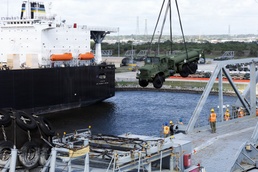
Sailors assigned to 2nd Navy Expeditionary Logistics Regiment moved combat equipment from sea to shore during Maritime Prepositioning Force Exercise 26 at Marine Corps Support Facility Blount Island, strengthening the Navy-Marine Corps team’s ability to sustain combat power across distributed maritime operations.
The late-May exercise in Northeast Florida integrated the USNS Red Cloud, Navy lighterage and specialized maritime infrastructure with a naval support element training alongside Blount Island Command’s experienced veteran workforce in ship-to-shore sustainment and littoral mobility operations.
In a single day, more than 20 vehicles moved across the USNS Red Cloud, berthed along Blount Island’s 1,000-foot slipway, as Sailors trained on crane lifts, line handling and staging operations. During instream operations on the St. Johns River, lighterage platforms transported vehicles between Blount Island and Naval Station Mayport near the Atlantic Ocean.
From the bridge, Cary Carrigan, a contracted lighterage specialist with Blount Island Command, monitored operations as a modular causeway ferry pulled alongside carrying heavy tactical vehicles. The ship’s crane lifted and swung them starboard in humid heat. The Improved Navy Lighterage System is designed to move equipment ashore when traditional port infrastructure is damaged or unavailable.
Carrigan, a retired Navy chief warrant officer 5, spent more than 30 years in naval service before retiring aboard USS Arlington (LPD 24), homeported at Naval Station Norfolk, Virginia. Today, he trains Sailors on the same type of ship-to-shore sustainment missions he once performed in uniform.
“Blount Island contains all the assets,” Carrigan said. “We have equipment, pier space, the infrastructure. We have established working relationships with Naval Station Mayport, the Coast Guard, civilian marinas and boat launches. Our workforce has the knowledge available from personnel who do this frequently in support of exercises and real-world events.”
Carrigan first conducted maritime operations and connector testing at Blount Island while serving in the Navy. After retirement, he returned to the facility as a contractor, continuing to train Sailors on operations he spent decades performing at sea.
Around him, naval service veterans employed as watercraft masters, engineers and crew members guided Sailors through vessel movements and crane lifts, maintaining situational awareness and ensuring proficiency. The facility preserves operational knowledge developed through overseas contingency operations and decades of service rather than losing it through separation or retirement.
Blount Island Command’s military-led, civilian-operated workforce maintains and distributes service-managed equipment supporting global forward-positioning programs while providing expeditionary forces with the technical expertise needed for large-scale ship-to-shore sustainment.
“For this exercise we are focusing on watch station training at the unit level, as we have several reservists and personnel conducting MPF operations for the first time,” Carrigan said. “Conducting throughput operations here at Blount Island allows the naval support element to hone fundamentals, build efficiency, shape operational relationships and increase future operational readiness.”
The exercise included active-duty and reserve Sailors from Navy Cargo Handling Battalion 1 and Navy Cargo Handling Battalion 11. Additional units operated vehicles, utility boats, causeway ferries and warping tugs and oversaw beach landing operations.
Sailors also completed multiple littoral transit missions between Blount Island and Naval Station Mayport to simulate longer ship-to-shore movements expected across island chains.
“At that distance, it’s about sustainability,” Carrigan said of the hourlong river transit, pointing to fuel, maintenance and crew endurance concerns. As Sailors trained to sustain longer littoral movements, the exercise also tested emerging autonomous capabilities supporting future maritime logistics operations.
MPFEX 26 included autonomous testing of the INLS during an at-sea demonstration with representatives from Amphibious Construction Battalion 1, Beachmaster Unit 2, Chief of Naval Operations for Installations and Logistics (OPNAV N4) and Program Management Office 314, Logistics Over the Shore.
Joseph Messenger, a work center supervisor with Naval Facilities Engineering and Expeditionary Warfare Center Software Support Activity, guided representatives aboard a utility boat into the Atlantic before transferring them onto an autonomous-enabled INLS navigating between programmed waypoints.
As the floating pier maneuvered independently through rolling seas with representatives braced against the waves, onboard radar systems continuously tracked shorelines, vessels and obstacles while a Sailor from Amphibious Construction Battalion 1 stood by the controls for manual intervention if needed.
“It can go from waypoint to waypoint on its own using collision avoidance,” said Rob Branan, an electrical engineer with Naval Facilities Engineering and Expeditionary Warfare Center who helped integrate the autonomous system into the INLS, adding that continued investment will help expand autonomous littoral sustainment capabilities in contested environments.
A Navy veteran and former aviation electrician’s mate, Branan built experience in electrical engineering, aviation simulation and automation systems before continuing Navy service as a civilian.
MPFEX 26 strengthened the regiment’s ability to coordinate equipment movement, tracking and staging in expeditionary logistics operations while reinforcing modernization efforts focused on sustaining combat power across distributed maritime operations.