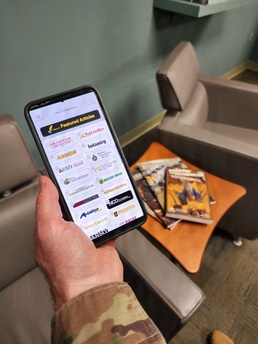
FORT LEAVENWORTH, Kansas – Military Professionals now have instant access to all Army branch journals through the new Line of Departure app, which currently delivers more than 1,200 professional military articles directly to the field.
Army University Press launched the app on May 12, 2026, expanding the reach of their Line of Departure website that previously consolidated the Army’s branch journals into a single, searchable interface. The new mobile version enhances the user experience by letting readers receive article alerts, build custom bookshelves, and share content with others.
Maj. Nate Green, a Harding Fellow for Armor Magazine, noted that the app’s ease of use directly meets reader needs on the go. “I am a big fan of the mobile app and how it brings resources to readers. In less than three clicks, I can be reading an article from a professional bulletin,” Green said.
Putting professional discourse and leadership lessons learned directly in Soldiers' hands supports the Army’s mandate to reinvigorate professional writing. Lt. Gen. Jim Isenhower, commanding general of the U.S. Army Combined Arms Command, emphasized the importance of effective writing earlier this year, calling it “a critical aspect of our Army profession.”
“Modernization is one of the key initiatives of the Line of Departure — to help all of the branch journals have a more modern capacity to provide lessons learned and share their content with Soldiers across the Army," said Michael Serravo, director of Line of Departure.
The mobile app builds upon a highly successful web foundation. Since its launch in October 2024, the centralized Line of Departure platform has acted as a force multiplier and an "equalizer" for smaller journal teams with minimal staffing. Website usage has consistently grown, reaching more than 50,000 views and 19,000 new visitors in April 2026 alone.
By pushing this established platform to mobile devices, the Army breaking down branch silos. Capt. Garett Pyle, Harding Fellow at the Army Sustainment Bulletin, noted that the centralized system provides an avenue to cross-communicate. “Now, I can easily view articles from other branches that I would otherwise never see. We are sharing insights and overall increasing Army lethality through this process,” Pyle said.
Sgt. 1st Class Marcel Blood, Harding Project deputy director and Ordnance noncommissioned officer, stressed the universal value of this information flow for the Total Force. “I can't stress enough that there is something in the journals for everyone. Whether you're on division staff and are trying to solve problems for the CG, or a Soldier learning to use a drone for the first time, there are articles published by your Soldiers, peers, and leaders that can help you,” he said.
Recognizing these benefits, Master Sgt. Travis Ragle, the co-editor in chief of the Special Warfare Journal, expects the mobile app to drive exponential growth in readership as awareness builds.
“The broader reach sparks discourse and coordination among branches, as well as assists in special operations recruitment through the amplified exposure Line of Departure provides,” Ragle said.
Readers can expect publication of approximately eight articles per branch journal each month[JB3.1]. Download the Line of Departure App on your mobile device’s app store.
<br> About Army University Press and Line of Departure
Army University Press serves as the U.S. Army’s premier multimedia organization, functioning as the entry point for rigorous tactical analysis, doctrinal debate, and discussion on emerging topics vital to national defense.
Line of Departure, in collaboration with the Harding Project, is leading the Army’s effort to modernize branch journals and reinvigorate professional military writing as part of the service’s broader transformation initiative.
• Visit the AUP website to learn more about its educational portfolio. • Visit Line of Departurehttps://www.google.com/url?q=https%3A%2F%2Fwww.lineofdeparture.army.mil%2Fto access all Army branch journals in one central location and find information on getting published.
(Note: This article references “Isenhower: Writing ‘Critical’ to Army Profession” which can be found https://www.ausa.org/news/isenhower-writing-critical-army-profession)