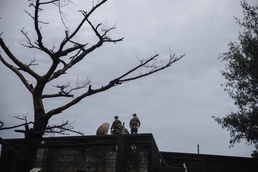
CAMP HANSEN, Okinawa, Japan — Rain hammered against camouflage netting as Marines with 7th Communication Battalion, III Marine Expeditionary Force Information Group, packed antennas, secured satellite equipment and loaded communications gear into waiting tactical vehicles during Kaiju Rain 26, Okinawa, Japan, May 9, 2026.
Generators shut down one by one as Marines rapidly displaced from one command-and-control location to another, rehearsing the movement and survivability required to maintain communications in a contested environment.
Kaiju Rain 26 is a III Marine Expeditionary Force Information Group-led exercise focused on strengthening distributed command-and-control, integrating information capabilities and improving operational readiness throughout the Indo-Pacific.
For communications Marines, the exercise was centered on one critical mission: staying connected while remaining difficult to detect.
“If you stay in a fixed place for too long, the adversaries can figure out where you’re at,” said 1st Lt. Kaden Cuevas, a communications officer with 7th Communication Battalion. “The reason why we practice moving is so we can go ahead and make sure that we stay alive as long as possible.”
Throughout the exercise, Marines established expeditionary communication nodes capable of supporting command-and-control operations while repeatedly displacing across Okinawa to simulate the challenges of operating against hostile forces capable of targeting fixed positions.
Cuevas, serving as the detachment officer in charge for a communications node during the exercise, oversaw approximately 39 Marines responsible for maintaining communications capabilities while maneuvering between locations.
May 9,during the exercise, Marines displaced from Camp Courtney to Camp Hansen’s Combat Town after simulating the compromise of a previous position. The movement forced Marines to rapidly tear down antennas, secure communication systems and re-establish command-and-control capabilities at a new site.
“The point of being there was simulating that first interaction with hostile forces,” said Sgt. Richard Bullock, a satellite communications operatorwith 7th Communication Battalion. “Then we jumped over to our fallback site, Combat Town. That’s simulating either that site fell through or that we just had to move.”
The displacement operations emphasized speed, mobility and survivability while operating in Okinawa’s demanding environment. Rain and humidity routinely interfered with communications equipment, forcing Marines to adapt in real time.
“One of the biggest problems we’ve seen out here so far is weather interfering with a lot of our communications gear,” Bullock said. “We’ve had to be creative with how we go about solving that and working around that problem.”
Bullock explained that Marines adjusted frequencies, switched between satellite bands and experimented with different antenna configurations to maintain reliable communications throughout the exercise.
The environmental challenges reinforced the importance of balancing concealment with communication effectiveness. “I think the most important part is giving people stable communications while also trying to stay as hidden as possible,” Cuevas said. “If people can’t talk, then we can’t control the battlefield. But at the same time, if everybody can see us, that makes us a pretty big target.”
As Marines established communications nodes beneath camouflage netting and concealed antennas among Okinawa’s terrain, the exercise tested the battalion’s ability to maintain command-and-control capabilities while reducing their physical and electronic signature.
Bullock described communications Marines as a critical link between commanders and the forces operating across the battlefield.
“Without communications, your commanders can’t tell the troops where to go, how to get there, or anything like that,” Bullock said. “Comms is one of the most important things for anyone, especially at the MEF level.”
The exercise also gave junior Marines opportunities to adapt to unfamiliar environments and solve problems independently while operating in the field.
“Sometimes you have to let the Marines work,” Cuevas said. “If you’re just on top of them all the time, then you don’t give them the space to work.”
For many Marines, Kaiju Rain 26 served as more than a communications exercise. It became an opportunity to learn how to operate faster, lighter and more efficiently while sustaining operations in the field for extended periods.
“We have to be quick and light,” Bullock said. “The minimal amount of gear that’s required for us to get fully operational.”
As rain continued to fall over Okinawa and Marines prepared for their next movement, the exercise reinforced the role communications Marines play in enabling command-and-control across the Indo-Pacific.
“At any moment, something could happen,” Cuevas said. “We need to practice how we’re going to play so when something actually happens, we can be as ready as we need to be.”