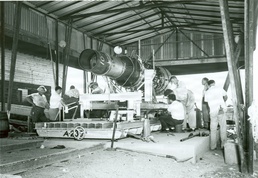
ARNOLD AIR FORCE BASE, Tenn. – Following the June 1951 dedication of the Arnold Engineering Development Center, construction on three major test facilities continued. At different points throughout the 1950s, the building of the Engine Test Facility, Gas Dynamics Facility and Propulsion Wind Tunnel Facility was completed. These facilities remain active to this day. ENGINE TEST FACILITY The ETF was the first of the trio to be finished. It is used for the development and evaluation testing of propulsion systems, including turbojet and turbofan air breathing engines and ramjets, for advanced aircraft and missiles. “The overall ETF facility will be primarily concerned with problems on various types of aircraft propulsion units and will be used to simulate actual flight operations of the units over a wide range of altitude and flight speed conditions,” states an AEDC news release issued in November 1953. Around a decade of planning, including three years of brick-and-mortar construction, went into bringing ETF to fruition. In September 1950, the Air Force began reconditioning and installing in the ETF Bavarian Motor Works equipment captured from Germany after World War II. The Germans had placed the BMW engine test plant in operation in 1944 to test and develop gas turbine engines. Following the war, the BMW plant was dismantled and shipped to the U.S. where it was stored until construction of AEDC was approved. “After refurbishment, this equipment became the cornerstone for the ETF, which was completed in 1953,” statesBeyond the Speed of Sound, a book detailing the history of AEDC. Utilization of seized German equipment in a new American test facility was recommended in mid-1945 by Frank Wattendorf, an American Scientist who was a member of the Scientific Advisory Group, or SAG. Formed at the behest of Gen. Henry “Hap Arnold, the SAG was tasked with providing recommendations on the future direction of U.S. aviation research. In May 1945, the group visited German to survey test facilities there. After this survey, Wattendorf documented his findings in a flight from Europe to the U.S. in a June 19, 1945, report that became known as the Trans-Atlantic Memo. In it, Wattendorf suggested that study be given to the establishment of a “new Air Forces research and development center,” the first recommendation for a center such as AEDC. He also wrote that captured German test equipment could be put to use at the new center. Funding programs for procurement and construction of the ETF were issued in February 1951. The design of all major ETF equipment was completed by the end of that same year. “When completed, this test unit will provide three air-tight chambers in which complete turbo-jet, turbo-prop, and ram-jet engines can be operated,” states the release issued in November 1953. In July 1953, after around three years of brick-and-mortar construction, the ETF was considered “essentially complete.” Shakedown work in the ETF began in the summer of 1953. A shakedown is an evaluation to ensure a facility is ready for full-scale operations. The first engine was fired at ETF in August 1953 when an open-air, outdoor instrumentation testing was initiated on a General Electric J47 turbojet engine. “Instrumentation testing of the J-47 engine will obtain engine performance data before calibration and shakedown tests begin in the Engine Test Facility this fall,” states an AEDC News Release from late August 1953. “The J-47 tests will probably require two months’ time in order to complete all the necessary engineering data.” The ETF began producing its first test data in March 1954. “Although several smaller wind tunnels at the Center have been doing testing work for more than a year, this marks the first time that one of the development center’s major laboratories has been placed into actual test operation,” states an AEDC release issued that month. This effort involved research on a one-eighth scale model of a part of the ETF Ram Jet Addition, an additional laboratory in the ETF for testing aircraft propulsion systems. The first simulated flight of a jet engine at AEDC occurred on May 3, 1954, in the ETF T-1 test cell. This test was also conducted using a J47 turbojet engine. A simulated altitude of 30,000 feet at a speed of approximately 500 miles per hour was achieved during the initial run. “Engineers and technicians operated the jet by remote control from a nearby control room where meters and gauges recorded the performance of the jet,” states an AEDC news release issued the day of the test. “The test runs with the J-47 are to shakedown and calibrate the test cell and the facility. Later tests will be concerned with development and operational testing of turbojet and ram-jet propulsion units for the aircraft industry and the armed services.” The J47 turbojet engine was later used to power the B-47 Stratojet bomber. By December 1954, all of the initial ETF test cells – T-1, T-2, T-4 and Test Bed T-5 – were being used for testing. VON KÁRMÁN GAS DYNAMICS FACILITY The von Kármán Gas Dynamics Facility is comprised of several wind tunnels used to acquire aerodynamic and aerothermodynamic data utilized in the development of high-speed flight vehicles. The SAG highlighted the need for such a facility in their report titled Toward New Horizons, published in December 1945 following the group’s May 1945 survey of German test facilities. In this document, the SAG championed the creation of a research and development facility that could be used for the study and development of jet propulsion, supersonic aircraft and ballistic missiles. “The Center for Supersonic and Pilotless Aircraft Development should be equipped with adequate wind tunnel facilities to attain speeds up to three times the velocity of sound, with large enough test sections to accommodate models of reasonable size, including jet propulsion units, and one ultrasonic wind tunnel for exploration of the upper frontier of the supersonic speed range,” an excerpt from Toward New Horizons states. “Ample facilities for the study of combustion and other characteristics of propulsion systems at very high altitudes should be provided.” The decision to proceed with a Gas Dynamics Facility at the new AEDC was made by representatives of the Air Force, Navy, National Advisory Committee for Aeronautics, the government’s Research Development Board and aircraft industry during a meeting in Washington, D.C., in early 1950. In February 1951, funding programs for procurement and construction of both this facility and the ETF were simultaneously issued. Later that same year, the commander of the Air Engineering Development Division, established in January 1950 to oversee the creation of AEDC, directed civil engineering firm Sverdrup & Parcel to proceed with the design of the Gas Dynamics Facility. The first test in the Gas Dynamics Facility occurred in September 1953 in tunnel E-1, a 12-inch supersonic tunnel that was the first major AEDC wind tunnel to be placed in full operation. This effort involved testing the Hughes Aircraft “Falcon,” and air-to-air guided aircraft rocket and marked the first test of a purely developmental type to take place at AEDC. The construction of additional wind tunnels followed, two of which were completed in 1957. The first test in the 40-inch supersonic tunnel occurred in June 1958 on nose cone configurations of the Thor weapon system. On Oct. 30, 1959, the Gas Dynamics Facility was dedicated as the von Kármán Gas Dynamics Facility in honor of mathematician, physicist and engineer Theodore von Kármán, who formed the Scientific Advisory Group at Gen. Arnold’s request. It was the first time that the Air Force had named a major facility for a living person. “There is no doubt in my mind that this is the greatest honor that I have ever experienced,” von Kármán said during the ceremony. “But I would have thought the Air Force would have waited a few years until I had the occasion to look back at this from beyond infinity. I think that is really the tradition, that the scientist, if he gets something dedicated in his name, should already be dead. But I am glad the Air Force managed an exception and gave me the opportunity to accept this honor.” Von Kármán passed away in May 1963. PROPULSION WIND TUNNEL Like the Engine Test and Gas Dynamics facilities, the origins of the Propulsion Wind Tunnel facility can be traced back to World War II when Gen. Arnold expressed concern over the Germans’ rapid progress in the development of high-performance jet aircraft and rocket-powered missiles. A U.S. facility dedicated to aerodynamic and propulsion integration testing on large-scale aircraft models was needed. The PWT was designed to meet this requirement. The PWT is made up of one supersonic and two transonic wind tunnels. The construction of transonic and supersonic wind tunnel facilities was specifically authorized by the Unitary Wind Tunnel Plan Act of 1949, comprised of bills that authorized a plan for the construction of wind tunnels to enhance national defense and appropriated money for the construction of AEDC. “The National Advisory Committee for Aeronautics and the Secretary of Defense are hereby authorized and directed jointly to develop a unitary plan for the construction of transonic and supersonic wind tunnel facilities for the solution of research, development and evaluation problems in aeronautics, including the construction of facilities at educational institutions within the continental limits of the United States for training and research in aeronautics, and to revise the uncompleted portions of the unitary plan from time to time to accord with changes in national defense requirements and scientific and technical advances,” the act states. Planning for PWT began in January 1950 when representatives from the aircraft propulsion industry met with the Air Force Research and Development Board on Facilities. They agreed there existed a need for a supersonic wind tunnel with a 15-foot test section. Test plans were revised, and the test section was enlarged to a 16-foot cross section. The funding program for PWT was issued in March 1951. By December 1951, the commanding general of AEDC had approved a proposal for the design, construction and operation of a scale model of the PWT transonic circuit. The initial operation of a test facility compressor at AEDC was conducted in this scale model tunnel, a 1-foot prototype tunnel known as “Pee Wee,” in mid-October 1952. On Oct. 21, 1952, supersonic flow was first achieved at AEDC when Pee Wee was placed into operation. “A wind tunnel capable of producing hurricane velocities over twice the speed of sound has been placed in operation at the Arnold Engineering Development Center in Tullahoma, Tennessee,” announced an AEDC news release issued Oct. 22, 1952. “This is the first of several test facilities being built at the AEDC to be placed in operation to assist in the development of jet engines, airplanes, and missiles.” The release further stated the small tunnel would be used to carry out research on problems associated with the operation of the larger transonic tunnel under design at the time. The now-inactive 1-foot tunnel served as the predecessor for the 16-foot transonic circuit of PWT, also known as 16T. “It will be used in the future to try out ideas for improvements or modifications of the full scale tunnel and to test installations proposed for the big tunnel, at model scale, in order to save time and money,” the released stated. In June 1953, the first test in PWT was conducted in the 1-foot tunnel on a 0.03-scale model of the Bomarc missile for the Boeing Company. 16T underwent its first powered calibration test in 1956. The first test involving a jet engine occurred in the wind tunnel the following year. In mid-1957, the nose cone proposed for the Air Force Atlas missile was tested in 16T. Among other early first tests conducted in 16T was a program involving a model of the B-58 Hustler, the country’s first supersonic bomber. The first test in the PWT 16-foot supersonic circuit, known as 16S, occurred in the early 1960s when AEDC personnel performed a parachute deployment test. Early efforts in 16S also included RS-70 inlet testing in early 1962. This was then the largest model ever tested in a wind tunnel, as it measured 75-feet long and weighed more than 200,000 pounds with support equipment. The first propulsion test occurred in 16S in the latter half of 1962 during a shakedown program on the J93 engine, the XB-70A propulsion system. At the time, this was the largest turbojet engine ever operated in a wind tunnel at supersonic speeds and high-altitude conditions. A 4-foot transonic wind tunnel, known as 4T, was added to the PWT in 1968. This tunnel was built to aid in the development of new weapons and to ensure stores could be safely released from high-speed aircraft. The first user test occurred in 4T in early 1968 at the request of the Air Force Armament Laboratory. It involved the testing of a Hard Structure Munition missile model at transonic speeds. The first store separation test in 4T occurred in April 1968.
This is the 16th in a series of articles highlighting the history of Arnold Engineering Development Complex during its first 75 years. Additional articles will be published throughout 2026 to commemorate the anniversary of AEDC.