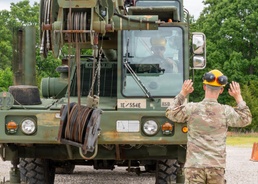
FORT LEONARD WOOD, Mo. — The U.S. Army Engineer School has expanded the C4 Crane Course at Fort Leonard Wood, doubling Soldier throughput this month to bolster force readiness.
“The Army needs more crane operators for their day-to-day operations,” USAES Command Sgt. Maj. David Palmer said. “We are transforming the course to meet the Army’s demands.”
Soldiers taking this course “are learning to use cranes to move large objects, such as shipping containers, concrete T-walls and barriers,” Palmer said “You will find these cranes at ports and sustainment nodes loading heavy equipment on and off ships, vehicles and trailers.”.
Administered by the 554th Engineer Battalion, 1st Engineer Brigade, this course serves as the sole pipeline for Soldiers to earn the C4 Crane Operator Additional Skill Identifier, significantly enhancing their technical engineering capabilities.
“Ensuring our Soldiers understand the proper way to utilize cranes and demonstrate the proper technique when operating them are the basics of this course,” Palmer said.
According to Desmond Walker, Horizontal Skills Division instructor supervisor, during the 27-day course, [12N Horizontal Construction Engineer](https://www.goarmy.com/careers-and-jobs/mechanics-engineering/design-develop/12n-horizontal-construction-engineer) and [88H Cargo Specialist](https://www.goarmy.com/careers-and-jobs/support-logistics/transportation-inventory/88h-cargo-specialist) Soldiers in the ranks of private to sergeant, learn to operate a 22-ton All Terrain Crane, known as an ATEC, and the 60-ton Type 2 Heavy Crane, called the T2HC.
Walker said the current curriculum focuses on how to use cranes for vehicle recovery, and to lift and position bridge sections, barriers and structural assemblies.
Soldiers who complete this training will be capable of supporting “horizontal and vertical engineering missions and multi-roll bridge companies with bridge building,” Walker said.
To maximize readiness alongside increased throughput, Palmer said the course is targeting high-demand operational units and has implemented a direct pipeline from Advanced Individual Training to the crane course for Soldiers with projected assignments to those units, as well as those identified by their initial entry training leadership.
“Precision manning allows us to identify units across the force with specific operational requirements for crane operators,” he said. “And by transitioning Soldiers directly from IET into this course, we are significantly optimizing resources.”
In the future, Palmer said the curriculum is projected to transition to updated equipment platforms, ensuring training remains synchronized with current operational requirements.